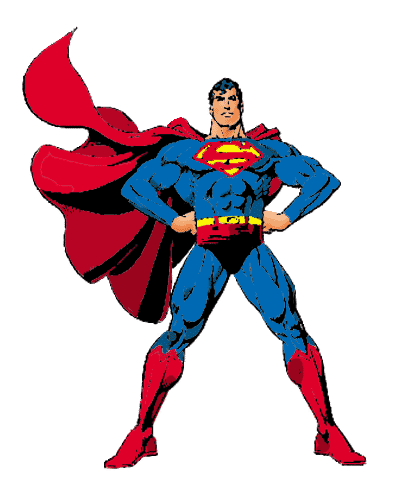
Superman is a fictional character, a comic book superhero appearing in publications by DC Comics, widely considered to be an American cultural icon. Created by American writer Jerry Siegel and Canadian-born American artist Joe Shuster in 1932 while both were living in Cleveland, Ohio, and sold to Detective Comics, Inc. (later DC Comics) in 1938, the character first appeared in Action Comics #1 (June 1938) and subsequently appeared in various radio serials, television programs, films, newspaper strips, and video games. With the success of his adventures, Superman helped to create the superhero genre and establish its primacy within the American comic book.[1] The character's appearance is distinctive and iconic: a blue, red and yellow costume, complete with cape, with a stylized "S" shield on his chest. This shield is now typically used across media to symbolize the character.
The original story of Superman relates that he was born Kal-El on the planet Krypton, before being rocketed to Earth as an infant by his scientist father Jor-El, moments before Krypton's destruction. Discovered and adopted by a Kansas farmer and his wife, the child is raised as Clark Kent and imbued with a strong moral compass. Very early he started to display superhuman abilities, which upon reaching maturity he resolved to use for the benefit of humanity.
While sometimes referred to less than flatteringly as "the big blue Boy Scout" by some of his fellow superheroes, Superman has also been referred to as "The Man of Steel", "The Man of Tomorrow", and "The Last Son of Krypton" over the years. As Clark Kent, Superman lives among humans as a "mild-mannered reporter" for the Metropolis newspaper Daily Planet (Daily Star in the earliest stories). There he works alongside reporter Lois Lane, with whom he is romantically linked. This relationship has been consummated by marriage on numerous occasions across various media, and this union is now firmly established within mainstream comics' continuity.
DC Comics slowly expanded the character's supporting cast, powers, and trappings throughout the years. Superman's backstory was altered to allow for adventures as Superboy, and other survivors of Krypton were created, including Supergirl and Krypto the Superdog. In addition, Superman has been licensed and adapted into a variety of media, from radio to television and film, perhaps most notably portrayed by Christopher Reeve in both Richard Donner's Superman: The Movie in 1978, and the sequel Superman II in 1981, which garnered critical praise and became Warner Bros.'s most successful feature films of their time. However, the next two sequels, Superman III and Superman IV: The Quest for Peace, did not perform as well at the box office. The motion picture Superman Returns was released in 2006, which although relatively unsuccessful within the United States, returned a performance at the international box office which exceeded expectations. It has been confirmed that a new Superman film will be released, with Henry Cavill portraying Superman. In the seven decades since Superman's debut, the character has been revamped and updated several times.
A significant overhaul occurred in 1986, when John Byrne revamped and "retconned" the character, reducing Superman's powers and erasing several characters from the canon, in a move that attracted media attention. Press coverage was again garnered by DC Comics in the 1990s with The Death of Superman, a storyline which saw the character killed (and later restored to life).
Superman has fascinated scholars, with cultural theorists, commentators, and critics alike exploring the character's impact and role in the United States and the rest of the world. Umberto Eco discussed the mythic qualities of the character in the early 1960s, and Larry Niven has pondered the implications of a sexual relationship the character might enjoy with Lois Lane. The character's ownership has often been the subject of dispute, with Siegel and Shuster twice suing for the return of legal ownership. The copyright is again currently in dispute, with changes in copyright law allowing Siegel's wife and daughter to claim a share of the copyright, a move DC parent company Warner Bros. disputes.
Publication history
Creation and conception
"The Reign of the Super-Man" in the fanzine Science Fiction, #3 (June 1933).
Jerry Siegel and Joe Shuster first created a bald telepathic villain bent on dominating the entire world. He appeared in the short story "The Reign of the Super-Man" from Science Fiction #3, a science fiction fanzine that Siegel published in 1933. Siegel re-wrote the character in 1933 as a hero, bearing little or no resemblance to his villainous namesake, modeling the hero on Douglas Fairbanks Sr. and his bespectacled alter ego, Clark Kent, on Harold Lloyd.[13][14] Siegel and Shuster then began a six-year quest to find a publisher. Titling it The Superman, Siegel and Shuster offered it to Consolidated Book Publishing, who had published a 48-page black-and-white comic book entitled Detective Dan: Secret Operative No. 48. Although the duo received an encouraging letter, Consolidated never again published comic books. Shuster took this to heart and burned all pages of the story, the cover surviving only because Siegel rescued it from the fire. Siegel and Shuster each compared this character to Slam Bradley, an adventurer the pair had created for Detective Comics #1 (March 1937).
Siegel contacted other artists to collaborate on the strip, according to Gerard Jones feeling that "Superman was going nowhere with Joe". Tony Strobl, Mel Graff and Russell Keaton were all contacted as potential collaborators by Siegel. Artwork produced by Keaton based on Siegel's treatment shows the concept evolving. Superman is now sent back in time as a baby by the last man on Earth, where he is found and raised by Sam and Molly Kent. However Keaton did not pursue the collaboration, and soon Siegel and Shuster were back working together on the character.
The pair re-envisioned the character, who became more of a hero in the mythic tradition, inspired by such characters as Samson and Hercules,[18] who would right the wrongs of Siegel and Shuster's times, fighting for social justice and against tyranny. It was at this stage the costume was introduced, Siegel later recalling that they created a "kind of costume and let's give him a big S on his chest, and a cape, make him as colorful as we can and as distinctive as we can." The design was based in part on the costumes worn by characters in outer space settings published in pulp magazines, as well as comic strips such as Flash Gordon, and also partly suggested by the traditional circus strong-man outfit, which comprised a pair of shorts worn over a contrasting bodysuit. However, the cape has been noted as being markedly different from the Victorian tradition. Gary Engle described it as without "precedent in popular culture" in Superman at Fifty: The Persistence of a Legend. The circus performer's shorts-over-tights outfit was soon established as the basis for many future superhero outfits. This third version of the character was given extraordinary abilities, although this time of a physical nature as opposed to the mental abilities of the villainous Superman.
The locale and the hero's civilian names were inspired by the movies, Shuster said in 1983. "Jerry created all the names. We were great movie fans, and were inspired a lot by the actors and actresses we saw. As for Clark Kent, he combined the names of Clark Gable and Kent Taylor. And Metropolis, the city in which Superman operated, came from the Fritz Lang movie [Metropolis, 1927], which we both loved".
Although they were by now selling material to comic book publishers, notably Malcolm Wheeler-Nicholson's National Allied Publishing, the pair decided to feature this character in a comic strip format, rather than in the longer comic book story format that was establishing itself at this time. They offered it to both Max Gaines, who passed, and to United Feature Syndicate, who expressed interest initially but finally rejected the strip in a letter dated February 18, 1937. However, in what historian Les Daniels describes as "an incredibly convoluted turn of events", Max Gaines ended up positioning the strip as the lead feature in Wheeler-Nicholson's new publication, Action Comics. Vin Sullivan, editor of the new book, wrote to the pair requesting that the comic strips be refashioned to suit the comic book format, requesting "eight panels a page". However Siegel and Shuster ignored this, utilizing their own experience and ideas to create page layouts, with Siegel also identifying the image used for the cover of Action Comics #1 (June 1938), Superman's first appearance. In February 2010, an original Action Comics #1 was sold at auction for $1,000,000.
Siegel may have been inspired to create the Superman character due to the death of his father. Mitchell Siegel was an immigrant who owned a clothing store on New York's Lower East Side. He died during a robbery attempt in 1932, a year before Superman was created. Although Siegel never mentioned the death of his father in interviews, both Gerard Jones and Brad Meltzer believe it must have affected him. "It had to have an effect," says Jones. "There's a connection there: the loss of a dad as a source for Superman." Meltzer states: "Your father dies in a robbery, and you invent a bulletproof man who becomes the world's greatest hero. I'm sorry, but there's a story there."
Publication
See also: List of Superman comics
Superman making his debut in Action Comics #1 (June 1938). Cover art by Joe Shuster.
Superman's first appearance was in Action Comics #1, in 1938. In 1939, a self-titled series was launched. The first issue mainly reprinted adventures published in Action Comics, but despite this the book achieved greater sales. The year 1939 also saw the publication of New York World's Fair Comics, which by summer of 1942 became World's Finest Comics. With issue #7 of All Star Comics, Superman made the first of a number of infrequent appearances, on this occasion appearing in cameo to establish his honorary membership in the Justice Society of America.
Initially Jerry Siegel and Joe Shuster provided the story and art for all the strips published. However, Shuster's eyesight began to deteriorate, and the increasing appearances of the character meant an increase in the workload. This led Shuster to establish a studio to assist in the production of the art, although he insisted on drawing the face of every Superman the studio produced. Outside the studio, Jack Burnley began supplying covers and stories in 1940, and in 1941 artist Fred Ray began contributing a stream of Superman covers, some of which, such as that of Superman #14 (February 1942), became iconic and much reproduced. Wayne Boring, initially employed in Shuster's studio, began working for DC in his own right in 1942 providing pages for both Superman and Action Comics. Al Plastino was hired initially to copy Wayne Boring but was eventually allowed to create his own style and became one of the most prolific Superman artists during the Gold and Silver Ages of comics.
The scripting duties also became shared. In late 1939 a new editorial team assumed control of the character's adventures. Whitney Ellsworth, Mort Weisinger and Jack Schiff were brought in following Vin Sullivan's departure. This new editorial team brought in Edmond Hamilton, Manly Wade Wellman, and Alfred Bester, established writers of science fiction.
By 1943, Jerry Siegel was drafted into the army in a special celebration, and as a result his contributions diminished. Don Cameron and Alvin Schwartz joined the writing team, Schwartz teaming up with Wayne Boring to work on the Superman comic strip, which had been launched by Siegel and Shuster in 1939.[29]
In 1945, Superboy made his debut in More Fun Comics #101. The character moved to Adventure Comics in 1946, and his own title, Superboy, was launched in 1949. The 1950s saw the launching of Superman's Pal Jimmy Olsen (1954) and Superman's Girlfriend Lois Lane (1958). By 1974 these titles had merged into Superman Family, although the series was cancelled in 1982. DC Comics Presents was a series published from 1978 to 1986 featuring team-ups between Superman and a wide variety of other characters of the DC Universe.
In 1986, a decision was taken to restructure the universe the Superman character inhabited with other DC characters in the mini-series Crisis on Infinite Earths, resulting in the publication of "Whatever Happened to the Man of Tomorrow", a two-part story written by Alan Moore, with art by Curt Swan, George Pérez and Kurt Schaffenberger.[32] The story was published in Superman #423 and Action Comics #583 and presented what Les Daniels notes as "the sense of loss the fans might have experienced if this had really been the last Superman tale."
Superman's origin is reimagined in The Man of Steel #1 (July 1986), written and drawn by John Byrne.
Superman was relaunched by writer & artist John Byrne, initially in the limited series The Man of Steel (1986). The year 1986 also saw the cancellation of World's Finest Comics, and the Superman title renamed Adventures of Superman. A second volume of Superman was launched in 1987, running until cancellation in 2006. After this cancellation, Adventures of Superman reverted to the Superman title. Superman: The Man of Steel was launched in 1991, running until 2003, while the quarterly book Superman: The Man of Tomorrow ran from 1995 to 1999. In 2003 Superman/Batman was launched as well as the Superman: Birthright limited series, with All Star Superman launched in 2005 and Superman Confidential in 2006 (this title was cancelled in 2008). He also appeared in the TV animated series-based comic book tie-ins Superman Adventures (1996–2002), Justice League Adventures, Justice League Unlimited (canceled in 2008) and The Legion of Super-Heroes In The 31st Century (canceled in 2008).
Current ongoing publications that feature Superman on a regular basis are Superman, Action Comics, Superman/Batman and Justice League of America. The character often appears as a guest star in other series and is usually a pivotal figure in DC crossover events.
The original story of Superman relates that he was born Kal-El on the planet Krypton, before being rocketed to Earth as an infant by his scientist father Jor-El, moments before Krypton's destruction. Discovered and adopted by a Kansas farmer and his wife, the child is raised as Clark Kent and imbued with a strong moral compass. Very early he started to display superhuman abilities, which upon reaching maturity he resolved to use for the benefit of humanity.
While sometimes referred to less than flatteringly as "the big blue Boy Scout" by some of his fellow superheroes, Superman has also been referred to as "The Man of Steel", "The Man of Tomorrow", and "The Last Son of Krypton" over the years. As Clark Kent, Superman lives among humans as a "mild-mannered reporter" for the Metropolis newspaper Daily Planet (Daily Star in the earliest stories). There he works alongside reporter Lois Lane, with whom he is romantically linked. This relationship has been consummated by marriage on numerous occasions across various media, and this union is now firmly established within mainstream comics' continuity.
DC Comics slowly expanded the character's supporting cast, powers, and trappings throughout the years. Superman's backstory was altered to allow for adventures as Superboy, and other survivors of Krypton were created, including Supergirl and Krypto the Superdog. In addition, Superman has been licensed and adapted into a variety of media, from radio to television and film, perhaps most notably portrayed by Christopher Reeve in both Richard Donner's Superman: The Movie in 1978, and the sequel Superman II in 1981, which garnered critical praise and became Warner Bros.'s most successful feature films of their time. However, the next two sequels, Superman III and Superman IV: The Quest for Peace, did not perform as well at the box office. The motion picture Superman Returns was released in 2006, which although relatively unsuccessful within the United States, returned a performance at the international box office which exceeded expectations. It has been confirmed that a new Superman film will be released, with Henry Cavill portraying Superman. In the seven decades since Superman's debut, the character has been revamped and updated several times.
A significant overhaul occurred in 1986, when John Byrne revamped and "retconned" the character, reducing Superman's powers and erasing several characters from the canon, in a move that attracted media attention. Press coverage was again garnered by DC Comics in the 1990s with The Death of Superman, a storyline which saw the character killed (and later restored to life).
Superman has fascinated scholars, with cultural theorists, commentators, and critics alike exploring the character's impact and role in the United States and the rest of the world. Umberto Eco discussed the mythic qualities of the character in the early 1960s, and Larry Niven has pondered the implications of a sexual relationship the character might enjoy with Lois Lane. The character's ownership has often been the subject of dispute, with Siegel and Shuster twice suing for the return of legal ownership. The copyright is again currently in dispute, with changes in copyright law allowing Siegel's wife and daughter to claim a share of the copyright, a move DC parent company Warner Bros. disputes.
Publication history
Creation and conception
"The Reign of the Super-Man" in the fanzine Science Fiction, #3 (June 1933).
Jerry Siegel and Joe Shuster first created a bald telepathic villain bent on dominating the entire world. He appeared in the short story "The Reign of the Super-Man" from Science Fiction #3, a science fiction fanzine that Siegel published in 1933. Siegel re-wrote the character in 1933 as a hero, bearing little or no resemblance to his villainous namesake, modeling the hero on Douglas Fairbanks Sr. and his bespectacled alter ego, Clark Kent, on Harold Lloyd.[13][14] Siegel and Shuster then began a six-year quest to find a publisher. Titling it The Superman, Siegel and Shuster offered it to Consolidated Book Publishing, who had published a 48-page black-and-white comic book entitled Detective Dan: Secret Operative No. 48. Although the duo received an encouraging letter, Consolidated never again published comic books. Shuster took this to heart and burned all pages of the story, the cover surviving only because Siegel rescued it from the fire. Siegel and Shuster each compared this character to Slam Bradley, an adventurer the pair had created for Detective Comics #1 (March 1937).
Siegel contacted other artists to collaborate on the strip, according to Gerard Jones feeling that "Superman was going nowhere with Joe". Tony Strobl, Mel Graff and Russell Keaton were all contacted as potential collaborators by Siegel. Artwork produced by Keaton based on Siegel's treatment shows the concept evolving. Superman is now sent back in time as a baby by the last man on Earth, where he is found and raised by Sam and Molly Kent. However Keaton did not pursue the collaboration, and soon Siegel and Shuster were back working together on the character.
The pair re-envisioned the character, who became more of a hero in the mythic tradition, inspired by such characters as Samson and Hercules,[18] who would right the wrongs of Siegel and Shuster's times, fighting for social justice and against tyranny. It was at this stage the costume was introduced, Siegel later recalling that they created a "kind of costume and let's give him a big S on his chest, and a cape, make him as colorful as we can and as distinctive as we can." The design was based in part on the costumes worn by characters in outer space settings published in pulp magazines, as well as comic strips such as Flash Gordon, and also partly suggested by the traditional circus strong-man outfit, which comprised a pair of shorts worn over a contrasting bodysuit. However, the cape has been noted as being markedly different from the Victorian tradition. Gary Engle described it as without "precedent in popular culture" in Superman at Fifty: The Persistence of a Legend. The circus performer's shorts-over-tights outfit was soon established as the basis for many future superhero outfits. This third version of the character was given extraordinary abilities, although this time of a physical nature as opposed to the mental abilities of the villainous Superman.
The locale and the hero's civilian names were inspired by the movies, Shuster said in 1983. "Jerry created all the names. We were great movie fans, and were inspired a lot by the actors and actresses we saw. As for Clark Kent, he combined the names of Clark Gable and Kent Taylor. And Metropolis, the city in which Superman operated, came from the Fritz Lang movie [Metropolis, 1927], which we both loved".
Although they were by now selling material to comic book publishers, notably Malcolm Wheeler-Nicholson's National Allied Publishing, the pair decided to feature this character in a comic strip format, rather than in the longer comic book story format that was establishing itself at this time. They offered it to both Max Gaines, who passed, and to United Feature Syndicate, who expressed interest initially but finally rejected the strip in a letter dated February 18, 1937. However, in what historian Les Daniels describes as "an incredibly convoluted turn of events", Max Gaines ended up positioning the strip as the lead feature in Wheeler-Nicholson's new publication, Action Comics. Vin Sullivan, editor of the new book, wrote to the pair requesting that the comic strips be refashioned to suit the comic book format, requesting "eight panels a page". However Siegel and Shuster ignored this, utilizing their own experience and ideas to create page layouts, with Siegel also identifying the image used for the cover of Action Comics #1 (June 1938), Superman's first appearance. In February 2010, an original Action Comics #1 was sold at auction for $1,000,000.
Siegel may have been inspired to create the Superman character due to the death of his father. Mitchell Siegel was an immigrant who owned a clothing store on New York's Lower East Side. He died during a robbery attempt in 1932, a year before Superman was created. Although Siegel never mentioned the death of his father in interviews, both Gerard Jones and Brad Meltzer believe it must have affected him. "It had to have an effect," says Jones. "There's a connection there: the loss of a dad as a source for Superman." Meltzer states: "Your father dies in a robbery, and you invent a bulletproof man who becomes the world's greatest hero. I'm sorry, but there's a story there."
Publication
See also: List of Superman comics
Superman making his debut in Action Comics #1 (June 1938). Cover art by Joe Shuster.
Superman's first appearance was in Action Comics #1, in 1938. In 1939, a self-titled series was launched. The first issue mainly reprinted adventures published in Action Comics, but despite this the book achieved greater sales. The year 1939 also saw the publication of New York World's Fair Comics, which by summer of 1942 became World's Finest Comics. With issue #7 of All Star Comics, Superman made the first of a number of infrequent appearances, on this occasion appearing in cameo to establish his honorary membership in the Justice Society of America.
Initially Jerry Siegel and Joe Shuster provided the story and art for all the strips published. However, Shuster's eyesight began to deteriorate, and the increasing appearances of the character meant an increase in the workload. This led Shuster to establish a studio to assist in the production of the art, although he insisted on drawing the face of every Superman the studio produced. Outside the studio, Jack Burnley began supplying covers and stories in 1940, and in 1941 artist Fred Ray began contributing a stream of Superman covers, some of which, such as that of Superman #14 (February 1942), became iconic and much reproduced. Wayne Boring, initially employed in Shuster's studio, began working for DC in his own right in 1942 providing pages for both Superman and Action Comics. Al Plastino was hired initially to copy Wayne Boring but was eventually allowed to create his own style and became one of the most prolific Superman artists during the Gold and Silver Ages of comics.
The scripting duties also became shared. In late 1939 a new editorial team assumed control of the character's adventures. Whitney Ellsworth, Mort Weisinger and Jack Schiff were brought in following Vin Sullivan's departure. This new editorial team brought in Edmond Hamilton, Manly Wade Wellman, and Alfred Bester, established writers of science fiction.
By 1943, Jerry Siegel was drafted into the army in a special celebration, and as a result his contributions diminished. Don Cameron and Alvin Schwartz joined the writing team, Schwartz teaming up with Wayne Boring to work on the Superman comic strip, which had been launched by Siegel and Shuster in 1939.[29]
In 1945, Superboy made his debut in More Fun Comics #101. The character moved to Adventure Comics in 1946, and his own title, Superboy, was launched in 1949. The 1950s saw the launching of Superman's Pal Jimmy Olsen (1954) and Superman's Girlfriend Lois Lane (1958). By 1974 these titles had merged into Superman Family, although the series was cancelled in 1982. DC Comics Presents was a series published from 1978 to 1986 featuring team-ups between Superman and a wide variety of other characters of the DC Universe.
In 1986, a decision was taken to restructure the universe the Superman character inhabited with other DC characters in the mini-series Crisis on Infinite Earths, resulting in the publication of "Whatever Happened to the Man of Tomorrow", a two-part story written by Alan Moore, with art by Curt Swan, George Pérez and Kurt Schaffenberger.[32] The story was published in Superman #423 and Action Comics #583 and presented what Les Daniels notes as "the sense of loss the fans might have experienced if this had really been the last Superman tale."
Superman's origin is reimagined in The Man of Steel #1 (July 1986), written and drawn by John Byrne.
Superman was relaunched by writer & artist John Byrne, initially in the limited series The Man of Steel (1986). The year 1986 also saw the cancellation of World's Finest Comics, and the Superman title renamed Adventures of Superman. A second volume of Superman was launched in 1987, running until cancellation in 2006. After this cancellation, Adventures of Superman reverted to the Superman title. Superman: The Man of Steel was launched in 1991, running until 2003, while the quarterly book Superman: The Man of Tomorrow ran from 1995 to 1999. In 2003 Superman/Batman was launched as well as the Superman: Birthright limited series, with All Star Superman launched in 2005 and Superman Confidential in 2006 (this title was cancelled in 2008). He also appeared in the TV animated series-based comic book tie-ins Superman Adventures (1996–2002), Justice League Adventures, Justice League Unlimited (canceled in 2008) and The Legion of Super-Heroes In The 31st Century (canceled in 2008).
Current ongoing publications that feature Superman on a regular basis are Superman, Action Comics, Superman/Batman and Justice League of America. The character often appears as a guest star in other series and is usually a pivotal figure in DC crossover events.