Fashion

Fashion
Showing posts with label character. Show all posts

Tuesday, July 19, 2011

Ali Baba

Ali Baba (Arabic: علي باباʿAli Bāba) is a fictional character from medieval Arabic literature. He is described in the adventure tale of Ali Baba and the Forty Thieves. Some critics believe that this story was added to One Thousand and One Nights by one of its European translators, Antoine Galland, an 18th-century French orientalist who may have heard it in oral form from a Middle Eastern story-teller from Aleppo. However, Richard F. Burton claimed it to be part of the original One Thousand and One Nights. The American Orientalist Duncan Black MacDonald discovered an Arabic-language manuscript of the legend at the Bodleian Library; however, it was later found to be counterfeited.

This story has been used as a popular pantomime plot such as in the pantomime/musical Chu Chin Chow (1916). Like many other folk tales frequently adapted for children, the original tale is darker and more violent than the more familiar bowdlerised versions. Popular perception of Ali Baba, and the way he is treated in popular media, sometimes implies that he was the leader of the "Forty Thieves": in the story he is actually an "honest man" whom fortune enables to take advantage of the thieves' robberies.

Story

Ali Baba and his elder brother Cassim are the sons of a merchant. After the death of their father, the greedy Cassim marries a wealthy woman and becomes well-to-do, building on their father's business—but Ali Baba marries a poor woman and settles into the trade of a woodcutter.

One day Ali Baba is at work collecting and cutting firewood in the forest, and he happens to overhear a group of forty thieves visiting their treasure store. The treasure is in a cave, the mouth of which is sealed by magic. It opens on the words "iftaH ya simsim" (commonly written as "Open Sesame" in English), and seals itself on the words "Close, Simsim" ("Close Sesame"). When the thieves are gone, Ali Baba enters the cave himself, and takes some of the treasure home.

Ali Baba by Maxfield Parrish (1909).

Ali Baba borrows his sister-in-law's scales to weigh this new wealth of gold coins. Unbeknownst to Ali, she puts a blob of wax in the scales to find out what Ali is using them for, as she is curious to know what kind of grain her impoverished brother-in-law needs to measure. To her shock, she finds a gold coin sticking to the scales and tells her husband, Ali Baba's rich and greedy brother, Cassim. Under pressure from his brother, Ali Baba is forced to reveal the secret of the cave. Cassim goes to the cave and enters with the magic words, but in his greed and excitement over the treasures forgets the magic words to get back out again. The thieves find him there, and kill him. When his brother does not come back, Ali Baba goes to the cave to look for him, and finds the body, quartered and with each piece displayed just inside the entrance of the cave to discourage any similar attempts in the future.

Ali Baba brings the body home, where he entrusts Morgiana, a clever slave-girl in Cassim's household, with the task of making others believe that Cassim has died a natural death. First, Morgiana purchases medicines from an apothecary, telling him that Cassim is gravely ill. Then, she finds an old tailor known as Baba Mustafa whom she pays, blindfolds, and leads to Cassim's house. There, overnight, the tailor stitches the pieces of Cassim's body back together, so that no one will be suspicious. Ali and his family are able to give Cassim a proper burial without anyone asking awkward questions.

The thieves, finding the body gone, realize that yet another person must know their secret, and set out to track him down. One of the thieves goes down to the town and comes across Baba Mustafa, who mentions that he has just sewn a dead man's body back together. Realizing that the dead man must have been the thieves' victim, the thief asks Baba Mustafa to lead the way to the house where the deed was performed. The tailor is blindfolded again, and in this state he is able to retrace his steps and find the house. The thief marks the door with a symbol. The plan is for the other thieves to come back that night and kill everyone in the house. However, the thief has been seen by Morgiana and she, loyal to her master, foils his plan by marking all the houses in the neighborhood with a similar marking. When the 40 thieves return that night, they cannot identify the correct house and the head thief kills the lesser thief. The next day, another thief revisits Baba Mustafa and tries again, only this time, a chunk is chipped out of the stone step at Ali Baba's front door. Again Morgiana foils the plan by making similar chips in all the other doorsteps. The second thief is killed for his stupidity as well. At last, the head thief goes and looks for himself. This time, he memorizes every detail he can of the exterior of Ali Baba's house.

The chief of the thieves pretends to be an oil merchant in need of Ali Baba's hospitality, bringing with him mules loaded with thirty-eight oil jars, one filled with oil, the other thirty-seven hiding the other remaining thieves. Once Ali Baba is asleep, the thieves plan to kill him. Again, Morgiana discovers and foils the plan, killing the thirty-seven thieves in their oil jars by pouring boiling oil on them. When their leader comes to rouse his men, he discovers that they are dead, and escapes.

To exact revenge, after some time the thief establishes himself as a merchant, befriends Ali Baba's son (who is now in charge of the late Cassim's business), and is invited to dinner at Ali Baba's house. The thief is recognized by Morgiana, who performs a dance with a dagger for the diners and plunges it into the heart of the thief when he is off his guard. Ali Baba is at first angry with Morgiana, but when he finds out the thief tried to kill him, he gives Morgiana her freedom and marries her to his son. Ali Baba is then left as the only one knowing the secret of the treasure in the cave and how to access it. Thus, the story ends happily for everyone except the forty thieves and Cassim.

Adaptations

  • The story was made into an Egyptian movie in 1942 as "Ali Baba We El Arbeen Haramy" (Alibaba and the Forty Thieves), with Ali AlKassar playing the lead as Ali Baba, and the comedian actor Ismail Yasin as his assistant.
  • A French film Ali Baba et les quarante voleurs starring Fernandel and Samia Gamal (1954).
  • A French telefilm starring Gérard Jugnot and Catherine Zeta-Jones (2007).
  • In 1970s Alibaba story was adapted in a Bengali film called 'Morgiana Abdulla'.
  • A Soviet-Indian joint film of 1979 Ali Baba aur 40 Chor, starring Dharmendra, Hema Malini, Rolan Bykov and Zeenat Aman, was largely based on this adventure tale.
  • A Malaysian comedy film, Ali Baba Bujang Lapok (1960) which quite faithfully adhered to the tale's plot details, but introduced a number of anachronisms for humour, for example the usage of a truck by Kassim Baba to steal the robbers' loot.
  • The story was made into a Tamil language movie in 1955-56 titled Alibabavum Narpadhu Thirudargalum ("Ali Baba and the Forty Thieves"), with M. G. Ramachandran playing the lead as Ali Baba and Bhanumathi Ramakrishna as Morgiana.
  • The story was adapted in the 1971 anime Ali Baba and the Forty Thieves (アリババと40匹の盗賊 Aribaba to Yonjuppiki no Tozoku?), storyboarded by Hayao Miyazaki.
  • The concept of Ali Baba and the Forty Thieves was used for the last installment of Disney's Aladdin series, Aladdin and the King of Thieves, released in 1996, introducing Cassim the King of Thieves as Aladdin's father.
  • In the television mini-series Arabian Nights, the story is told faithfully with two major changes. The first is that when Morgiana discovers the thieves in the oil jars, she alerts Ali Baba and together with a friend, they release the jars on a street with a steep incline and allow them roll down to break open. Furthermore, the city guard is alerted and arrest the disoriented thieves as they emerge from their containers. Later when Morgiana defeats the thief leader, Ali Baba, who is young and has no children, marries the heroine himself.
  • A film adaption Ali Baba and the Forty Thieves was made in 1944. The film was remade in 1965 as The Sword of Ali Baba. Frank Puglia portrayed the character named Kassim in both versions.
  • At the United States Air Force Academy, Cadet Squadron 40 was originally nicknamed "Ali Baba and the Forty Thieves" before eventually changing its name to the "P-40 Warhawks"
  • A mythopoeic novel by Tom Holt, 'Open Sesame', is based on characters from the story of "Ali Baba and the Forty Thieves"

In other media

  • A 1981 computer video game by Quality Software.
  • A 1982 arcade video game by Taito.
  • A Tamil movie featuring Krishna Kulasekaran
  • In the video game Sonic and the Secret Rings, Miles "Tails" Prower is Ali Baba. Despite the fact that the forty thieves appear in the game as spirits and reanimated skeletons, he has no involvement with them at all.
  • In the MASH episode, "The Novocaine Mutiny," Frank Burns accuses Benjamin Pierce of mutiny. When Pierce displays his typical nonchalance, Burns states: "Ali Baba 'til the very end, aren't you?"
  • A Merrie Melodies Bugs Bunny/Daffy Duck cartoon, Ali Baba Bunny, has a similar premise to the concept of the treasure-filled magical cave, in which Daffy Duck is consumed by the same greed as Cassim.[vague]
  • A Looney Tunes cartoon with Porky Pig called Ali-Baba Bound, but this one portrays Ali Baba as a villain who attempts to attack the desert fort.
  • In a song "Ali Baba's Camel" by Noel Gay Ali Baba is specifically identified ("Forty thieves had he"). This song is now best known in the cover version by the Bonzo Dog Doo-Dah Band. Joint credit to Hulton (who?) is sometimes given; e.g. with the blessing of Neil Innes at .
  • In the Beastie Boys song "Rhymin & Stealin" they make reference to Ali Baba and the forty thieves.
  • A John Holt song, Ali Baba
  • Ali Baba and the Forty Thieves, a computer game for the Apple II published in 1982.
  • In the video game Spyro: Enter the Dragonfly the level Thieves' Den is a parody of the tale.
  • Dark Lotus of Psychopathic records has a song named Ali Baba.
  • A Popeye Cartoon, Popeye the Sailor Meets Ali Baba's Forty Thieves, features Popeye meeting, and defeating the titular group.
  • In the video game Sly 3: Honor Among Thieves, it is said that one of Sly Cooper's ancestors, Salim al Kupar of Arabia, had the stealth of forty-thieves. It is not said if this ancestor was part of the forty-thieves however.
  • A Los Garcias' song, Ali Baba
  • A Dara Puspita song, Ali Baba


  • In the video game Diablo II, "The Blade of Ali Baba" is the name of a unique sword that can be found, it increases the amount of gold and magical items dropped by monsters when it is used to slay them.
  • In the Sean Biggs (ft. Akon) song, "Never Gonna Get It" there is a reference to "chains hangin' like Ali Baba".
  • In the Disney film Aladdin there are several references to the story. During the Genie's song "Friend like Me" he lists the benefits other heroes have had in their adventures, including "Ali Baba had them forty thieves". Another possible reference is Aladdin's alias "Prince Ali Ababwa", which is very similar to Ali Baba. Also, in Aladdin and the King of Thieves the forty thieves play an integral part in the story. However the story is very different than the original Ali Baba story, particularly Cassim's new role as the King of Thieves.
  • A large illuminated tableau created for Blackpool Illuminations in 2005.
  • In the MMORPG (Massive Multiplayer Online Role Playing Game) Granado Espada and all its counterparts in other countries, a "cash shop" costume is named Ali Baba. This costume belongs to Alejandro, One of the Unique Player Characters in the game.
  • In the MMORPG (Massive Multiplayer Online Role Playing Game) Tales Runner an indirect reference is made to Ali Baba, a map is named Ali Baba Map.
  • In the 3CE song 'Take You To The Edge' the lyrics say 'Ali Baba had 40 thieves'
  • In Command & Conquer: Generals – Zero Hour, Mission 4 of the GLA campaign is named Jarmen Kell and the Forty Thieves making a reference to Ali Baba and the 40 thieves although Jarmen Kell was only sent together with a few Hijackers and Rebels that number less than 40.
  • In the video game Team Fortress 2, "Ali Baba's Wee Booties" is the name of a weapon the Demoman can equip, it increases your maximum health and increases turning speed while charging.

Iraq War

  • The name Ali Baba was often used as derogatory slang by American and Iraqi soldiers and their allies in the War in Iraq to describe individuals suspected of a variety of offenses related to theft and looting. British soldiers routinely used the term to refer to Iraqi civilians. In the subsequent occupation it is used as a general term for the insurgents, similar to Charlie for the Viet Cong in the Vietnam War.
  • Due to interaction of the two peoples, the term Ali Baba was adopted by the Iraqis to describe foreign troops suspected of looting, and the English-speaking mainstream press mistakenly reported the slang to be native to the locals

Saturday, May 14, 2011

James Bond

James Bond 007 is a fictional character created in 1953 by writer Ian Fleming, who featured him in twelve novels and two short story collections. The fictional British Secret Intelligence Service agent has also been used in the longest running and most financially successful English-language film franchise to date, starting in 1962 with Dr. No

After Fleming's death in 1964, subsequent James Bond novels were written by Kingsley Amis, John Gardner, Raymond Benson, Sebastian Faulks and Jeffery Deaver. Moreover, Christopher Wood novelised two screenplays, Charlie Higson wrote a series on a young James Bond while other writers have authored unofficial versions of the character.

There have been 22 films in the EON Productions series to date, the most recent of which, Quantum of Solace, was released on 31 October 2008 (UK). In addition there has been an American television adaptation and two independent feature productions. Apart from movies and television, James Bond has also been adapted for many other media, including radio plays, comic strips and video games.

The EON Productions films are generally termed as "official", by fans of the series, originating with the purchase of the James Bond film rights by producer Harry Saltzman in the early 1960s.

Creation and inspiration

Basic Bond coat of arms with motto

Commander Sir James Bond, (KCMG, RNVR) is an officer of the British Secret Intelligence Service (SIS; commonly known as MI6). He was created in January 1952 by British journalist Ian Fleming while on holiday at his Jamaican estate, Goldeneye. The hero was named after the American ornithologist James Bond, a Caribbean bird expert and author of the definitive field guide book Birds of the West Indies. Fleming, a keen birdwatcher, had a copy of Bond's field guide at Goldeneye. Of the name, Fleming once said in a Reader's Digest interview, "I wanted the simplest, dullest, plainest-sounding name I could find, 'James Bond' was much better than something more interesting, like 'Peregrine Carruthers.' Exotic things would happen to and around him, but he would be a neutral figure — an anonymous, blunt instrument wielded by a government department."

Nevertheless, news sources speculated about real spies or other covert agents after whom James Bond might have been modelled or named, such as Sidney Reilly or William Stephenson, best-known by his wartime intelligence codename of Intrepid. Although they are similar to Bond, Fleming confirmed none as the source figure, nor did Ian Fleming Publications nor any of Fleming's biographers, such as John Pearson or Andrew Lycett. Historian Keith Jeffery speculates in his authorized history of MI6, that Bond may be modeled on Fleming's close friend, Bill "Biffy" Dunderdale, a MI6 agent whose sophisticated persona and penchant for pretty women and fast cars closely matches that of Bond.

James Bond's parents are Andrew Bond, from village of Glencoe (Argyll, Scotland), and Monique Delacroix, from Yverdon (Vaud, Switzerland). Their nationalities were established in On Her Majesty's Secret Service. Fleming emphasised Bond's Scottish heritage in admiration of Sean Connery's cinematic portrayal, whereas Bond's mother is named after a Swiss fiancée of Fleming's. A planned, but unwritten, novel would have portrayed Bond's mother as a Scot. Ian Fleming was a member of a prominent Scottish banking family.[13] Although John Pearson's fictional biography of Bond gives him a birth date on 11 November (Armistice Day) 1920, the books themselves are inconsistent on the matter. In Casino Royale, he is said to have bought a car in 1933 and to have been an experienced gambler before World War II. Two books later, in Moonraker, he is said to be in his mid-thirties; the setting of this book can be no earlier than 1954 as it refers to the South Goodwin Lightship, which was lost in that year. There is a further reference to Bond's age in You Only Live Twice, when Tanaka tells him he was born in the Year of the Rat (1924/25 or 1912/13). The books were written over a 12-year period during which Bond's age, when mentioned, thus varies, but is usually around 40. In the novel On Her Majesty's Secret Service, Bond's family motto is found to be Orbis non sufficit ("The world is not enough"). The novel also states that the family that used this motto may not necessarily be the same Bond family from which James Bond came.

Hoagy Carmichael—another James Bond visual model.

After completing the manuscript for Casino Royale, Fleming allowed his friend (and later editor) William Plomer to read it. Plomer liked it and submitted it to Jonathan Cape, who did not like it as much. Cape finally published it in 1953 on the recommendation of Fleming's older brother Peter, an established travel writer.

Most researchers agree that James Bond is a romanticised version of Ian Fleming, himself a jet-setting womaniser. Both Fleming and Bond attended the same schools, preferred the same foods (scrambled eggs and coffee), maintained the same habits (drinking, smoking, wearing short-sleeve shirts), shared the same notions of the perfect woman in looks and style, and had similar naval career paths (both rising to the rank of naval Commander). They also shared similar height, hairstyle, and eye colour. Some suggest that Bond's suave and sophisticated persona is based on that of a young Hoagy Carmichael. In Casino Royale, Vesper Lynd remarks, "Bond reminds me rather of Hoagy Carmichael, but there is something cold and ruthless." Likewise, in Moonraker, Special Branch Officer Gala Brand thinks that Bond is "certainly good-looking . . . Rather like Hoagy Carmichael in a way. That black hair falling down over the right eyebrow. Much the same bones. But there was something a bit cruel in the mouth, and the eyes were cold."

Fleming did admit to being partly inspired by a story recounted to him which took place during his service in the Naval Intelligence Division of the Admiralty. The incident is depicted in Casino Royale, when Ralph Izzard finds himself involved in a card game, playing poker against covert Nazi intelligence agents at a casino in Pernambuco, Brazil.

Novels and related works

In February 1952, Ian Fleming began writing his first James Bond novel. At the time, Fleming was the foreign manager for Kemsley Newspapers, owners of The Daily Express in London. Upon accepting the job, Fleming asked for two months' yearly vacation in his contract—time spent writing in Jamaica. Between 1953 and his death in 1964, Fleming published twelve novels and one short-story collection (a second collection was published posthumously). Later, continuation novels were written by Kingsley Amis (as Robert Markham), John Gardner, Charlie Higson, and Raymond Benson, who was the first American author of James Bond. The Young Bond series of novels was begun in 2005, by Charlie Higson.

In July 2007, it was announced that Sebastian Faulks has been commissioned to write a new Bond novel to commemorate Fleming's 100th Birthday. The book — titled Devil May Care – was published on 27 May 2008.

The EON films

In the late 1950s, EON Productions guaranteed the film adaptation rights for every 007 novel except for Casino Royale (those rights were recovered in 1999). In 1962, the first adaptation Dr. No was made, which featured Sean Connery as 007. Connery starred in six more films after his initial portrayal (including 1983's Never Say Never Again, which was not part of the EON series). George Lazenby replaced Connery (for one film) before the latter's last EON film Diamonds Are Forever, after which the part was played by Roger Moore (for seven films), Timothy Dalton (for two films), Pierce Brosnan (for four films) and Daniel Craig (two films to 2008). As of 2008, there have been 22 films in the EON series. The 21st film, Casino Royale, with Daniel Craig as James Bond, premiered on 14 November 2006, with the film going on general release in Asia and the Middle East the following day. Notably, it is the first Bond film to have been released in China. The second James Bond film to feature Craig is Quantum of Solace, which gets its title from a short story of the same name by Ian Fleming (For Your Eyes Only, 1960), but shares no similarities with the plot.

In April 2010, EON Productions suspended development of Bond 23 indefinitely due to MGM's crippling debt and uncertain future. Prior to this suspension, Craig was expected to return to the franchise for a third time. On 11 January 2011, MGM sent out a press releasing announcing the 23rd Bond film, starring Daniel Craig, will be released on 9 November 2012. The press release reveals that "Sam Mendes [is] directing [the] screenplay written by Neal Purvis, Robert Wade and John Logan."

The film series has grossed over $4 billion (£2 billion) (nearly $11 billion when adjusted for inflation) worldwide, making it the highest grossing film series ever. The 22nd and newest movie in the series, Quantum of Solace, was released in the UK on 31 October 2008. As of 9 November 2008, global box office totals for Quantum of Solace were almost $161 million (£103 million), placing the Bond series ahead of the Harry Potter film series even when not adjusting for inflation


Sunday, February 13, 2011

Super Man


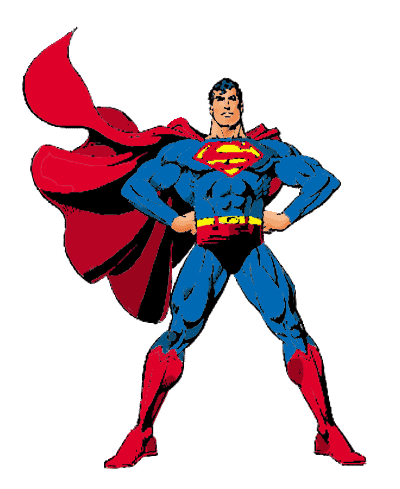
Superman is a fictional character, a comic book superhero appearing in publications by DC Comics, widely considered to be an American cultural icon. Created by American writer Jerry Siegel and Canadian-born American artist Joe Shuster in 1932 while both were living in Cleveland, Ohio, and sold to Detective Comics, Inc. (later DC Comics) in 1938, the character first appeared in Action Comics #1 (June 1938) and subsequently appeared in various radio serials, television programs, films, newspaper strips, and video games. With the success of his adventures, Superman helped to create the superhero genre and establish its primacy within the American comic book.[1] The character's appearance is distinctive and iconic: a blue, red and yellow costume, complete with cape, with a stylized "S" shield on his chest. This shield is now typically used across media to symbolize the character.
The original story of Superman relates that he was born Kal-El on the planet Krypton, before being rocketed to Earth as an infant by his scientist father Jor-El, moments before Krypton's destruction. Discovered and adopted by a Kansas farmer and his wife, the child is raised as Clark Kent and imbued with a strong moral compass. Very early he started to display superhuman abilities, which upon reaching maturity he resolved to use for the benefit of humanity.
While sometimes referred to less than flatteringly as "the big blue Boy Scout" by some of his fellow superheroes, Superman has also been referred to as "The Man of Steel", "The Man of Tomorrow", and "The Last Son of Krypton" over the years. As Clark Kent, Superman lives among humans as a "mild-mannered reporter" for the Metropolis newspaper Daily Planet (Daily Star in the earliest stories). There he works alongside reporter Lois Lane, with whom he is romantically linked. This relationship has been consummated by marriage on numerous occasions across various media, and this union is now firmly established within mainstream comics' continuity.
DC Comics slowly expanded the character's supporting cast, powers, and trappings throughout the years. Superman's backstory was altered to allow for adventures as Superboy, and other survivors of Krypton were created, including Supergirl and Krypto the Superdog. In addition, Superman has been licensed and adapted into a variety of media, from radio to television and film, perhaps most notably portrayed by Christopher Reeve in both Richard Donner's Superman: The Movie in 1978, and the sequel Superman II in 1981, which garnered critical praise and became Warner Bros.'s most successful feature films of their time. However, the next two sequels, Superman III and Superman IV: The Quest for Peace, did not perform as well at the box office. The motion picture Superman Returns was released in 2006, which although relatively unsuccessful within the United States, returned a performance at the international box office which exceeded expectations. It has been confirmed that a new Superman film will be released, with Henry Cavill portraying Superman. In the seven decades since Superman's debut, the character has been revamped and updated several times.
A significant overhaul occurred in 1986, when John Byrne revamped and "retconned" the character, reducing Superman's powers and erasing several characters from the canon, in a move that attracted media attention. Press coverage was again garnered by DC Comics in the 1990s with The Death of Superman, a storyline which saw the character killed (and later restored to life).
Superman has fascinated scholars, with cultural theorists, commentators, and critics alike exploring the character's impact and role in the United States and the rest of the world. Umberto Eco discussed the mythic qualities of the character in the early 1960s, and Larry Niven has pondered the implications of a sexual relationship the character might enjoy with Lois Lane. The character's ownership has often been the subject of dispute, with Siegel and Shuster twice suing for the return of legal ownership. The copyright is again currently in dispute, with changes in copyright law allowing Siegel's wife and daughter to claim a share of the copyright, a move DC parent company Warner Bros. disputes.

Publication history
Creation and conception

"The Reign of the Super-Man" in the fanzine Science Fiction, #3 (June 1933).
Jerry Siegel and Joe Shuster first created a bald telepathic villain bent on dominating the entire world. He appeared in the short story "The Reign of the Super-Man" from Science Fiction #3, a science fiction fanzine that Siegel published in 1933. Siegel re-wrote the character in 1933 as a hero, bearing little or no resemblance to his villainous namesake, modeling the hero on Douglas Fairbanks Sr. and his bespectacled alter ego, Clark Kent, on Harold Lloyd.[13][14] Siegel and Shuster then began a six-year quest to find a publisher. Titling it The Superman, Siegel and Shuster offered it to Consolidated Book Publishing, who had published a 48-page black-and-white comic book entitled Detective Dan: Secret Operative No. 48. Although the duo received an encouraging letter, Consolidated never again published comic books. Shuster took this to heart and burned all pages of the story, the cover surviving only because Siegel rescued it from the fire. Siegel and Shuster each compared this character to Slam Bradley, an adventurer the pair had created for Detective Comics #1 (March 1937).
Siegel contacted other artists to collaborate on the strip, according to Gerard Jones feeling that "Superman was going nowhere with Joe". Tony Strobl, Mel Graff and Russell Keaton were all contacted as potential collaborators by Siegel. Artwork produced by Keaton based on Siegel's treatment shows the concept evolving. Superman is now sent back in time as a baby by the last man on Earth, where he is found and raised by Sam and Molly Kent. However Keaton did not pursue the collaboration, and soon Siegel and Shuster were back working together on the character.
The pair re-envisioned the character, who became more of a hero in the mythic tradition, inspired by such characters as Samson and Hercules,[18] who would right the wrongs of Siegel and Shuster's times, fighting for social justice and against tyranny. It was at this stage the costume was introduced, Siegel later recalling that they created a "kind of costume and let's give him a big S on his chest, and a cape, make him as colorful as we can and as distinctive as we can." The design was based in part on the costumes worn by characters in outer space settings published in pulp magazines, as well as comic strips such as Flash Gordon, and also partly suggested by the traditional circus strong-man outfit, which comprised a pair of shorts worn over a contrasting bodysuit. However, the cape has been noted as being markedly different from the Victorian tradition. Gary Engle described it as without "precedent in popular culture" in Superman at Fifty: The Persistence of a Legend. The circus performer's shorts-over-tights outfit was soon established as the basis for many future superhero outfits. This third version of the character was given extraordinary abilities, although this time of a physical nature as opposed to the mental abilities of the villainous Superman.
The locale and the hero's civilian names were inspired by the movies, Shuster said in 1983. "Jerry created all the names. We were great movie fans, and were inspired a lot by the actors and actresses we saw. As for Clark Kent, he combined the names of Clark Gable and Kent Taylor. And Metropolis, the city in which Superman operated, came from the Fritz Lang movie [Metropolis, 1927], which we both loved".
Although they were by now selling material to comic book publishers, notably Malcolm Wheeler-Nicholson's National Allied Publishing, the pair decided to feature this character in a comic strip format, rather than in the longer comic book story format that was establishing itself at this time. They offered it to both Max Gaines, who passed, and to United Feature Syndicate, who expressed interest initially but finally rejected the strip in a letter dated February 18, 1937. However, in what historian Les Daniels describes as "an incredibly convoluted turn of events", Max Gaines ended up positioning the strip as the lead feature in Wheeler-Nicholson's new publication, Action Comics. Vin Sullivan, editor of the new book, wrote to the pair requesting that the comic strips be refashioned to suit the comic book format, requesting "eight panels a page". However Siegel and Shuster ignored this, utilizing their own experience and ideas to create page layouts, with Siegel also identifying the image used for the cover of Action Comics #1 (June 1938), Superman's first appearance. In February 2010, an original Action Comics #1 was sold at auction for $1,000,000.
Siegel may have been inspired to create the Superman character due to the death of his father. Mitchell Siegel was an immigrant who owned a clothing store on New York's Lower East Side. He died during a robbery attempt in 1932, a year before Superman was created. Although Siegel never mentioned the death of his father in interviews, both Gerard Jones and Brad Meltzer believe it must have affected him. "It had to have an effect," says Jones. "There's a connection there: the loss of a dad as a source for Superman." Meltzer states: "Your father dies in a robbery, and you invent a bulletproof man who becomes the world's greatest hero. I'm sorry, but there's a story there."
Publication
See also: List of Superman comics

Superman making his debut in Action Comics #1 (June 1938). Cover art by Joe Shuster.
Superman's first appearance was in Action Comics #1, in 1938. In 1939, a self-titled series was launched. The first issue mainly reprinted adventures published in Action Comics, but despite this the book achieved greater sales. The year 1939 also saw the publication of New York World's Fair Comics, which by summer of 1942 became World's Finest Comics. With issue #7 of All Star Comics, Superman made the first of a number of infrequent appearances, on this occasion appearing in cameo to establish his honorary membership in the Justice Society of America.
Initially Jerry Siegel and Joe Shuster provided the story and art for all the strips published. However, Shuster's eyesight began to deteriorate, and the increasing appearances of the character meant an increase in the workload. This led Shuster to establish a studio to assist in the production of the art, although he insisted on drawing the face of every Superman the studio produced. Outside the studio, Jack Burnley began supplying covers and stories in 1940, and in 1941 artist Fred Ray began contributing a stream of Superman covers, some of which, such as that of Superman #14 (February 1942), became iconic and much reproduced. Wayne Boring, initially employed in Shuster's studio, began working for DC in his own right in 1942 providing pages for both Superman and Action Comics. Al Plastino was hired initially to copy Wayne Boring but was eventually allowed to create his own style and became one of the most prolific Superman artists during the Gold and Silver Ages of comics.
The scripting duties also became shared. In late 1939 a new editorial team assumed control of the character's adventures. Whitney Ellsworth, Mort Weisinger and Jack Schiff were brought in following Vin Sullivan's departure. This new editorial team brought in Edmond Hamilton, Manly Wade Wellman, and Alfred Bester, established writers of science fiction.
By 1943, Jerry Siegel was drafted into the army in a special celebration, and as a result his contributions diminished. Don Cameron and Alvin Schwartz joined the writing team, Schwartz teaming up with Wayne Boring to work on the Superman comic strip, which had been launched by Siegel and Shuster in 1939.[29]
In 1945, Superboy made his debut in More Fun Comics #101. The character moved to Adventure Comics in 1946, and his own title, Superboy, was launched in 1949. The 1950s saw the launching of Superman's Pal Jimmy Olsen (1954) and Superman's Girlfriend Lois Lane (1958). By 1974 these titles had merged into Superman Family, although the series was cancelled in 1982. DC Comics Presents was a series published from 1978 to 1986 featuring team-ups between Superman and a wide variety of other characters of the DC Universe.
In 1986, a decision was taken to restructure the universe the Superman character inhabited with other DC characters in the mini-series Crisis on Infinite Earths, resulting in the publication of "Whatever Happened to the Man of Tomorrow", a two-part story written by Alan Moore, with art by Curt Swan, George Pérez and Kurt Schaffenberger.[32] The story was published in Superman #423 and Action Comics #583 and presented what Les Daniels notes as "the sense of loss the fans might have experienced if this had really been the last Superman tale."

Superman's origin is reimagined in The Man of Steel #1 (July 1986), written and drawn by John Byrne.
Superman was relaunched by writer & artist John Byrne, initially in the limited series The Man of Steel (1986). The year 1986 also saw the cancellation of World's Finest Comics, and the Superman title renamed Adventures of Superman. A second volume of Superman was launched in 1987, running until cancellation in 2006. After this cancellation, Adventures of Superman reverted to the Superman title. Superman: The Man of Steel was launched in 1991, running until 2003, while the quarterly book Superman: The Man of Tomorrow ran from 1995 to 1999. In 2003 Superman/Batman was launched as well as the Superman: Birthright limited series, with All Star Superman launched in 2005 and Superman Confidential in 2006 (this title was cancelled in 2008). He also appeared in the TV animated series-based comic book tie-ins Superman Adventures (1996–2002), Justice League Adventures, Justice League Unlimited (canceled in 2008) and The Legion of Super-Heroes In The 31st Century (canceled in 2008).
Current ongoing publications that feature Superman on a regular basis are Superman, Action Comics, Superman/Batman and Justice League of America. The character often appears as a guest star in other series and is usually a pivotal figure in DC crossover events.