Fashion

Fashion

Sunday, January 30, 2011

sport bike


A sport bike, also written as sportbike, is a motorcycle optimized for speed, acceleration, braking, and cornering on paved roads, typically at the expense of comfort and fuel economy in comparison to less specialized motorcycles Soichiro Honda wrote in the owners manual of the 1959 Honda CB92 Benly Super Sport that, "Primarily, essentials of the motorcycle consists in the speed and the thrill," while Cycle World's Kevin Cameron says more prosaically that, "A sportbike is a motorcycle whose enjoyment consists mainly from its ability to perform on all types of paved highway — its cornering ability, its handling, its thrilling acceleration and braking power, even (dare I say it?) its speed."
Motorcycles are versatile and may be put to many uses as the rider sees fit. In the past there were few if any specialized types of motorcycles, but the number of types and sub-types has proliferated, particularly in the period since the 1950s.[8] The introduction of the Honda CB750 in 1969 marked a dramatic increase in the power and speed of practical and affordable sport bikes available to the general public.

The groundbreaking inline four of the Honda CB750.
This was followed in the 1970s improvements in sport bike suspension and braking consummate with the power of the large inline fours that had begun to dominate the sport bike world. In the 1980s sport bikes again took a leap ahead, becoming almost indistinguishable from racing motorcycles.[5][9][12][13] Since the 1990s sport bikes have become more diverse, adding new variations like the naked bike and streetfighter to the more familiar road racing style of sport bike
Design elements
Dual front disc brakes with four piston radial calipers on a Yamaha YZF-R6.

Aftermarket upgrades using carbon fiber or other exotic materials are used on sport bikes to enhance the power-to-weight ratio and handling.
With the emphasis of a sport bike being on speed, acceleration, braking, and maneuverability, there are certain design elements that most motorcycles of this type will share. Rider ergonomics favor function. This generally means higher foot pegs that move the legs closer to the body and more of a reach to a lower set of hand controls, such as clip on handlebars, which positions the body and weight forward and over the tank. Sport bikes have comparatively high-performance engines resting inside a lightweight frame. High tech and expensive materials are often used on sport bikes to reduce weight.
Braking systems combine higher performance brake pads and disc brakes with multi-piston calipers that clamp onto oversized vented rotors. Suspension systems are advanced in terms of adjustments and materials for increased stability and durability. Front and rear tires are larger and wider than tires found on other types of motorcycles to allow higher cornering speeds and greater lean angles. Fairings may or may not be used on a sport bike; when used, fairings are shaped to reduce aerodynamic drag as much as possible and provide wind protection for the rider.[6]
The combination of rider position, location of the engine and other heavy components, and the motorcycle's geometry help maintain structural integrity and chassis rigidity, and determine how it will behave under acceleration, braking, and cornering. Correct front-to-rear weight distribution is of particular importance to the handling of sport bikes, and the changing position of the rider's body dynamically changes the handling of the motorcycle.Because of the complexity of modeling all the possible movements of different sized riders, to approach perfect tuning of a motorcycle's weight distribution and suspension is often only possible by having a bike customized or at least adjusted to fit a specific rider. Generally, road racing style sport bikes have shorter wheelbases than those intended for more comfortable touring, and the current trend in sport bike design is towards shorter wheelbases, giving quicker turning at the expense of a greater tendency for unintentional wheelies and stoppies under hard acceleration and braking, respectively.[15][16][17]
[edit] Classes

The Kawasaki Ninja 250R lightweight sport bike.

The Triumph Daytona 675 triple is usually classed as a middleweight or supersport.

A Yamaha YZF-R1 998 cc (60.9 cu in) superbike.

Touring with a passenger on an open class Suzuki Hayabusa.
There is no universal authority defining the terminology of sport bikes or any other motorcycle classes. Legal definitions are limited by local jurisdiction, and race sanctioning bodies like the American Motorcyclist Association (AMA) and the Fédération Internationale de Motocyclisme (FIM) set rules that only apply those who choose to participate in their competitions. Nonetheless, by present day standards in Europe, North America and the rest developed world, sport bikes are usually divided into three, four, or five rough categories, reflecting vaguely similar engine displacement, horsepower, price and intended use, with a good measure of subjective opinion and fudging for the sake of simplicity. Marketing messages about a model from the manufacturer can diverge from the consensus of the motorcycling media and the public. Sometimes the classes used in motorcycle racing are approximated in production models, often but not always in connection with homologation.
The sport bike classes in common usage are:
Lightweight, also called entry level, small or beginner bikes. Some two strokes in this class have dramatically higher performance than the four strokes, being likened to miniature superbikes.[12] Sport bikes with engine displacements of up to about 500 cc (31 cu in) are usually in this class.[4]
Middleweight,[18] mid-sized, mid-level,[14] or supersport.[12] Some of the models in this range qualify for racing in the classes AMA Supersport Championship, British Supersport Championship and the Supersport World Championship, but many middleweights do not have a significant presence in racing. Displacements of 600–750 cc (37–46 cu in) are typical.[4]
Superbike,[18] liter-class, or literbike, i.e 1,000 cc (61 cu in).[4] As with supersport, many of the models in this class compete in superbike racing.
Open class, hypersport or hyperbike are terms sometimes used in lieu of superbike as a catch-all for everything larger than middleweight. Alternatively, these terms mark a class above the superbikes for the largest displacement sport bikes with the highest top speeds, with weights somewhat greater than the superbike class.

The terms supersport and superbike are sometimes applied indiscriminately to all high performance motorcycles. Categorization by engine displacement alone is a crude measure, particularly when comparing engines with different numbers of cylinders like inline or V fours with parallel and V twins, not to mention the greater power for a given displacement of two-stroke engines over four strokes.

In the less developed world, smaller engine sizes are the norm, and relative terms like small, mid sized and large displacement can have different meanings. For example, in India in 2002 there were about 37 million two-wheelers, but as of 2008, there were only about 3,000 motorcycles, or fewer than one in 12,000, of displacement 1,000 cc (61 cu in) or more. Similarly, the perception of relative sizes has shifted over time in developed countries, from smaller to larger displacements.When the original superbike,[9][11] the Honda CB750, appeared in 1969, it was called a "big four," while today an inline four of 736.5 cc (44.94 cu in) would be classed in the middle range.
Besides having product lines that span from entry level through high end sport bikes, many manufacturers add depth[36] to that line by having pairs, or several pairs, of similar sport bikes aimed at riders of different levels. These are designed to appeal to riders seeking more or less extreme performance features. The more expensive model will be in the vein of a race replica, offering the latest technology updated with frequent design revisions, while the lower cost model typically relies on older technology, can have a more relaxed riding position, and is generally more practical for non-road racing tasks such as urban commuting and carrying passengers or baggage, and offering lower fuel, insurance and maintenance costs. Examples of these paired models are Buell's Firebolt and Lightning, Ducati's 916/748 through 1198/848 paired series, Honda's CBR600RR and F4i middleweights[8] and RC51 and CBR100RR liter-class, several different concurrent models in Kawasaki's Ninja line, and Yamaha's R6 and 600R.[4]
[edit] Variations

A BMW R1100RS sport-touring motorcycle.
Sport touring motorcycles share many features of sport bikes but may be considered a class all their own. These are mid- to large-sized motorcycles that offer more carrying capacity, more relaxed ergonomics, and more versatility than specialized sport bikes, while being lighter and more agile than touring motorcycles.[5][6][8][14][20][37]
Some sport bikes are marketed as race replicas, implying that the model sold to the public is identical to the one used in racing, or at least is closer to the racing version than non-replica models. Suffixes R or RR applied to model codes can be interpreted as standing for replica or race replica. The term race replica can also be used to distinguish the period of sport bike production from Japan and Europe since the mid 1980s, representing an evolution from the prior the superbike period that began in 1969.[8][9][10][11][12] The sport bike, or race replica, era begun with the 1984 Honda VF750F[13][38] or the 1985 Suzuki GSX-R750[9][12] has been dominated by full fairings,[5] but sport bikes with small or no fairings have proliferated since the mid 1990s, called naked bikes and streetfighters.[12][39] These bikes retain many of performance features of other sport bikes, but, besides abbreviated bodywork, they give the rider a more upright posture, by using, for example, higher handlebars instead of clip ons. The streetfighter name, associated with motorcycle stunt riding and perhaps hooliganism on public roads, can imply higher performance than the sometimes more tame naked bike, which in some cases is a synonym for standard motorcycle.

Others define naked bikes as equal in power and performance to sport bikes, merely absent the bodywork.

The Yamaha V-Max power cruiser.
The same period that saw the naked and streetfighter variants of the sport bike theme also had a resurgence of the versatile standard in response to demand for a return of the Universal Japanese motorcycle.[6][8] Supermoto-style street bikes, constructed with a completely different set of priorities than a road racing style sport bike, have also entered the mainstream, offering another option for riders seeking a spirited riding experience. The nickname muscle bike has been applied to sport bikes that give engine output a disproportionate priority over braking, handling or aerodynamics, harking back to the Japanese superbikes of the 1970s. A similar sensibility drives the so-called power cruiser motorcycles, based on cruiser class machines but with horsepower numbers in league with

rules for miss world


Rule 1(Eat Every 2.5 – 3 Hours) This usually equates to eating six small meals per day, but I cannot stress enough that this only works if your meals are nutritious and in small proportions; you can’t eat six dinners a day and fight fat.
Rule 2(Only Eat Until Full) If you can master this habit of only eating until full (you will be able to utilise the benefits of Rule No.3), you are headed for spectacular results.
Rule 3 (Eat A Variety Of Foods - Practicing Moderation)You can eat whatever you like, providing that you don't 'over-do it'. I encourage a day where you are less restrictive in what you eat than other days so you give yourself some freedom and don’t fell like your on a ‘diet’.
Rule 4(Change Your Beliefs About Yourself) Set yourself some high standards. Just because you may have failed in your attempts in the past, it does not mean that you can not succeed this time. Accept the importance of supportive beliefs rather than self-destructive and the self-defeating type actions. Realise that in order for a person to quickly and permanently change - then they will need to create what is known as leverage. They will need to create many reasons for wanting to make this change (the more reasons the better) only by doing this, can they realise the many benefits that will be derived if the change is made. This can be further reinforced or leveraged by attaching immense pain to no change. However, do not focus primarily on the pain aspect - focus more on the benefits to be derived from the new 'you'. In your imagination picture the ‘new you’, believe he / she is real. By doing this, you are literally sowing the seed to bring the ‘new you’ to life. There is no need to use stress and strain to force a mental state, just do it in a relaxed state without 'forcing' any particular feelings or thoughts. Guide your imagination - don't push it. The best times to perform this mental exercise / visualization are upon awakening in the morning and before sleep at night.
Rule 5 (Do Not Eat High Fat Foods In Combination With High Sugar Foods) Understand how eating high fat food in combination with high sugar foods (especially late at night) maximises fat retention. High sugar foods elevate Insulin levels, the higher the Glycemic index, the greater the Insulin response. One role of Insulin as a potent hormone is to store dietary fats, therefore, if you eat a high fat food with a high sugar food, you are placing your body in a physiological state to store dietary fat and you are also supplying the dietary fat that will ultimately be stored.Eating the high fat / high sugar combination just before going to bed escalates the problem as your body will store even more fat during sleep due to the bodies inactivity.
Rule 6 – (Weight Train To Metabolise Fat Longer) Weight training has a large effect at burning body fat indirectly. This is due to the fact, that muscle requires more energy just to exist than fat does. Your metabolism becomes faster from weight training regularly. An added benefit is the temporary increase of metabolism for many hours after weight training. For maximum fat loss, it is best to exercise early in the day (such as in the morning) to take full advantage of this fact.
For long term, lasting results, choose a routine that:
· You Enjoy
· Fits in with your lifestyle (Time constraints etc)
· Is sufficiently intense to stimulate muscular growth with out over-training and allows sufficient time between body parts for full recovery
When you finally settle on a system of training that benefits you, stick to it. Do not keep changing just for the sake of change. If you hit a sticking point with a routine that has been working well, just make subtle changes to get it working again.
Rule 7 (Do Some Aerobic Work)
Aerobic work burns fat calories. The most efficient intensity for fat burning is conversation pace. Weight bearing exercises such as running and walking burn more calories per hour than non-weight bearing such as swimming - so if you are limited for time, do weight bearing exercises.
Preferably do the aerobic work straight after weight training when your Glycogen levels are low. This will help burn more body fat. Two to Three, 30 - 45 minute sessions per week, are sufficient. Do not overdo the aerobic work.
Rule 8 – (Take The Fat Weight off with a High Protein Low Carb Type Diet)
A high protein low carbohydrate diet is not for everyone and should not be used for long term but for short term fat loss and lean mass retention it is very effective.
Rule 9 – (Regulate Your Protein Intake)
You don’t have to be on a high protein low carbohydrate diet for this rule, it applies to anyone weight training and wanting to obtain a leaner physique. You need to keep your protein intake at around 2.2 grams per kilo of bodyweight per day. This will help minimize the chances of losing valuable muscle tissue.
Rule 10 – (Learn The Previous Nine Rules And Put Some Of Them Immediately Into Practice, So That They Become A Habit)
We are creatures of habit; the trick is to become a 'master of good habits' rather than a 'slave to bad habits'.
Make working out FUN; bring a partner, do something different, try training at different times of the day, get a personal trainer to motivate you.

Miss Universe


Miss Universe is an annual international beauty contest run by the Miss Universe Organization The pageant is the most publicized beauty contest in the world with 600 million viewers.
The contest was founded in 1952 by California clothing company Pacific Mills. The pageant became part of Kayser-Roth and then Gulf and Western Industries, before being acquired by Donald Trump in 1996.

In 1998, Miss Universe changed its name from Miss Universe, Inc. to Miss Universe Organization and the headquarters moved from Long Beach California, to New York City that year. Donald Trump brought in a new team of professionals to the contest headed by its new CEO, Molly Miles, and president Maureen Reidy. Miles coined the slogan "Redefined for Today" for promotion of the pageants. That year, the new Miss Universe logo was born: The Woman with the Stars, which is still used today.
The current Miss Universe is Ximena Navarrete, from Mexico. She won the title on August 23, 2010.
History
The first use of the title "Miss Universe" was as part of International Pageant of Pulchritude which began in 1926. These events, the first international contests, lasted until 1935 when the Great Depression and other events preceding World War II led to their demise. This pageant had no direct relationship with the modern event.
The winner of the later "Miss America 1951" pageant, Yolande Betbeze, refused to pose in a swimsuit from its major sponsor, Catalina swimwear. As a result, the brand's manufacturer Pacific Mills withdrew from Miss America and set up the Miss USA and Miss Universe contests. The first Miss Universe Pageant was held in Long Beach, California in 1952. It was won by Armi Kuusela from Finland, who gave up her title though not officially to get married, shortly before her year was complete. Until 1958 the Miss Universe title (like Miss America) was post-dated, so at the time Ms. Kuusela's title was Miss Universe 1953.
The pageant was first televised in 1955. CBS began nationally broadcasting the combined Miss USA and Miss Universe pageants from 1960 and, separately, from 1965. In 2003 NBC took over the television rights.
[edit] Competition formats
In the early years of the pageant, the delegates who made the cut were announced after the preliminary competition. From 1965 to the present day, the semi-finalists were not announced until the night of the main event. The semi-finalists once again competed in evening gown and swimsuit and a top 5 were announced. An interview portion was introduced in 1960 to decide the runners-up and winner.
From 1959 to 1964, there were slight format changes. In 1959 through 1963, there was no cut to 5 finalists; the runners-up and winners were called from the assembled 15 semi-finalists. In 1964, the top 15 became a top 10, and after a round of interview, the winner and runners-up were called from the 10 finalists.
In 1965, the pageant returned to the original format of a cut to 5 finalists, and remained so until 1989.
In 1969, a final question was posed to the last five contestants. The final question was an on-and-off feature of the pageant. In 1990, it had taken root and every pageant since, the final contestants have to answer a final question.
In 1990, the pageant implemented major format changes in the competition itself. Instead of five finalists, the field was reduced from 10 semi-finalists to 6. Each contestant then randomly selected a judge and answered the question posed by the judge. After that, the field was narrowed down further to a final 3. In 1998, the number of finalists was reduced to 5, although there still was a cut to a final 3. This continued to 2001, where the final 5 format was re-instated.
In 2000, the interview portion of the semi-finals was quietly dropped and the contestants once again, as in the early days of the pageant, competed only in swimsuit and gowns.
In 2003, the Top 15 was again selected instead of the Top 10. Cuts were made to make the Top 10, and eventually the Top 5. The final question varied, each coming from the final delegates themselves and the current Miss Universe.
In 2006, twenty semi-finalists were announced, with these delegates competing in the swimsuit competition. The number of competing delegates was then cut to ten, with those delegates competing in the evening gown competition. After that round of competition, the final five were announced, with the finalists competing in the "final question" or interview round. At the end of competition the runners-up were announced and the winner crowned by the outgoing queen.
In 2007 the format changed slightly with the top 15 moving to the swimsuit competition; from there, 10 selected contestants moved on to the evening gown competition where half were eliminated. The final five were competing in the "final question". At the end of competition the runners-up were announced an the winner crowned by the outgoing queen.
[edit] The contest today
The Miss Universe Organization, a New York–based partnership between NBC and Donald Trump, has run the contest since June 20, 2002. The current president is Paula Shugart. The Organization sells television rights to the pageant in other countries, and also produces the Miss USA and Miss Teen USA contests with the winner of Miss USA representing the USA in Miss Universe.
[edit] Contestant selection
Each year, bids are received by the Miss Universe organizers from organizations who wish to select the Miss Universe contestant for a country. This allows competition between different pageants to hold a country's license, as happened for Miss Italy and Miss France for example, when the licenses for their respective traditional organizations were revoked (the usual Miss France competition returned in 2004).
Usually a country's candidate selection involves pageants in major cities, with the winners competing in a national pageant, but this does not always occur. For example, in 2000 Australia's national pageant was abolished as a relic of a bygone era, with Australian delegates instead chosen by a modeling agency. Such "castings" are generally discouraged by the Miss Universe Organization, which prefers national pageants that preserve an aura of respectability and competition. Despite being "cast", Miss Australia, Jennifer Hawkins, was chosen as Miss Universe 2004. Later that year, Australia resumed its national pageant and chose Michelle Guy as Miss Universe Australia 2005.
Some of the most successful national pageants in the last decade have been Venezuela, USA, Puerto Rico, etc. which command consistently high interest and television ratings in their respective countries.[8] Recent arrivals in the pageant include China (2002), Albania (2002), Vietnam (2004), Georgia (2004), Ethiopia (2004), Latvia (2005), Kazakhstan (2006), Tanzania (2007), and Kosovo (2008); there have also been efforts to revive strong national pageants in South Africa, Canada, Spain, Japan; Latin America (especially Venezuela, Puerto Rico, Dominican Republic, Mexico, Colombia and Brazil) among other regions. Prior powerhouses are Finland, Germany and Sweden. England is the most successful non-winning country with nine Top 5 positions.
There are continually efforts to expand the pageant, but the participation of some countries such as Algeria has proven difficult due to cultural barriers to the swimsuit competition, while others such as Azerbaijan, Mozambique, Armenia and Nepal have balked at sending representatives due to the cost (in fact, of all the major international pageants, the franchise fee for Miss Universe is the most expensive). As of 2010, only four countries have been present at every Miss Universe since its inception in 1952: Canada, France, Germany, and the United States. Many European countries allow 17-year-old contestants to compete in their pageants, while Miss Universe's minimum age is 18, so national titleholders often have to be replaced by their runners-up. Miss Universe also prohibits transsexual applicants and age fabrication.
Main pageant
The main Miss Universe Pageant, as of this writing, is held over a two week period in May and July. In the 1970s through the 1990s, the pageant was a month long. This allowed time for rehearsals, appearances, and the preliminary competition, with the winner being crowned by the previous year's titleholder during the final competition.
According to the organizers, the Miss Universe contest is more than a beauty pageant: women aspiring to become Miss Universe must be intelligent, well-mannered, and cultured. Often a candidate has lost because she did not have a good answer during the question responses rounds; although this section of competition has held less importance during recent pageants than it did in the twentieth century. Delegates also participate in swimsuit and evening gown competitions.
Currently, the final placement of the finalists is determined by a ranked vote, where each judge ranks each of the final three/five candidates, with the contestant posting the lowest cumulative score (thus often, but not necessarily always, the contestant with the most number one votes) becoming the winner. If there is a tie, the higher semifinal scores become decisive.
The winner is assigned a one-year contract with the Miss Universe Organization, going overseas to spread messages about the control of diseases, peace, and public awareness of AIDS. Since Donald Trump took over the pageant, the winner has been given the use of a Trump Tower apartment in New York City for use during her reign.
Aside from the main winner and her runners-up, special awards are also given to the winners of the best National Costume, Miss Photogenic, and Miss Congeniality. The Miss Congeniality award is chosen by the delegates themselves. In recent years, Miss Photogenic has been chosen by popular internet vote (the winner used to be chosen by media personnel covering the event).
Final judgment
The competition for the Miss Universe title has seen many changes, although there have been several constants throughout its history. All the contestants compete in a preliminary round of judging (nowadays called the "Presentation Show") where the field is narrowed to a select number of semi-finalists. This number has fluctuated over the years. The very first Miss Universe pageant had ten semi-finalists. The next two years, the number of semi-finalists grew to 16. In 1955, the number dropped to a stable 15, which remained through 1970. In 1971, the number was reduced to 12. That number was further reduced to a mere 10 in 1984. This lasted until 2003, when the number of 15 was re-instated. In 2006, there were 20 semi-finalists, the highest number ever. In 2007, the Organization announced the Top 15 system would be back, which was also used in 2008.
In the early years, the contestants were judged in swimsuit and evening gown only. In later years, the contestants also competed in a preliminary interview round in a one-on-one meeting with each individual judge.
In 2007, 77 contestants started the competition; the top 15 moving to the swimsuit competition. From there, 10 were selected for the evening gown competition which halved the contenders to 5. These final five then answered a final question to decide the winner.
Crown
The Miss Universe crown used from 2002–2007 was designed by Mikimoto, the official jewellery sponsor of the Miss Universe Organization, and depicted the phoenix rising, signifying status, power and beauty. The crown has 500 diamonds of almost 30 carats (6.0 g), 120 South Sea and Akoya pearls, ranging in size from 3 to 18 mm diameter and is valued at $250,000. The Crown was designed specifically for the pageant on Mikimoto Pearl Island in Japan with the Mikimoto crown and tiara being first used for Miss Universe 2002. Since 2009, Diamond Nexus Labs made Miss Universe crown. The crown is set with 1,371 gemstones, weighing a total of 416.09 carats (83.22 g). It contains 544.31 grams of 14k and 18k white gold as well as platinum.

Musical score
2004 marked the first year for the Miss Universe pageant to use the Orenté musical score, the official Miss Universe soundtrack. The Orenté musical score is divided into eight sequences: the Orenté Introduction — the musical score played during the live telecast as the voice over begins the Miss Universe pageant, the Orenté Major — used for the cue after commercial and during the announcement of the newly crowned Miss Universe, the Orenté Elimination — used for the announcement of semi-finalists, the Orenté Fashion Presentation, the Orenté Interlude — used while showing the ten finalists, the Orenté Pregunta Final — used while the final five finalists answer the final question the Orenté Final Look — used for the final look of the five finalists, and the Orenté Announcement — used while announcing the positions of the final five delegates. In 2008, a new Orenté Fashion Presentation was played during the Fadil Berisha swimsuit photoshoot, the 2008 version was now the called the Orenté Curtain Call, which was used as Melanie B and Jerry Springer called out the delegates just before they made the first cut, making the Orenté musical score divided into nine sequences.

Television Histoty


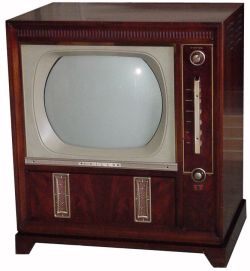
Television was not invented by a single inventor, instead many people working together and alone over the years, contributed to the evolution of television.
Overview - Timeline of Television History
Broadcasting Pioneers: The Many Innovators Behind Television HistoryAt the dawn of television history there were two distinct paths of technology experimented with by researchers.
Early inventors attempted to either build a mechanical television system based on the technology of Paul Nipkow's rotating disks; or they attempted to build an electronic television system using a cathode ray tube developed independently in 1907 by English inventor A.A. Campbell-Swinton and Russian scientist Boris Rosing.
Electronic television systems worked better and eventual replaced mechanical systems.
Paul Gottlieb Nipkow - Mechanical Television HistoryGerman, Paul Nipkow developed a rotating-disc technology to transmit pictures over wire in 1884 called the Nipkow disk. Paul Nipkow was the first person to discover television's scanning principle, in which the light intensities of small portions of an image are successively analyzed and transmitted.
John Logie Baird - MechanicalIn the 1920's, John Logie Baird patented the idea of using arrays of transparent rods to transmit images for television. Baird's 30 line images were the first demonstrations of television by reflected light rather than back-lit silhouettes. John Logie Baird based his technology on Paul Nipkow's scanning disc idea and later developments in electronics.
Charles Francis Jenkins - MechanicalCharles Jenkins invented a mechanical television system called radiovision and claimed to have transmitted the earliest moving silhouette images on June 14, 1923.
Cathode Ray Tube - Electronic Television HistoryElectronic television is based on the development of the cathode ray tube, which is the picture tube found in modern TV sets. German scientist, Karl Braun invented the cathode ray tube oscilloscope (CRT) in 1897.
Vladimir Kosma Zworykin - ElectronicRussian inventor, Vladimir Zworykin invented an improved cathode-ray tube called the kinescope in 1929. The kinescope tube was sorely needed for television. Zworykin was one of the first to demonstrate a television system with all the features of modern picture tubes.
Philo T. Farnsworth - ElectronicIn 1927, Philo Farnsworth was the first inventor to transmit a television image comprised of 60 horizontal lines. The image transmitted was a dollar sign. Farnsworth developed the dissector tube, the basis of all current electronic televisions. He filed for his first television patent in 1927 (#1,773,980).
Louis Parker - Television ReceiverLouis Parker invented the modern changeable television receiver. The patent was issued to Louis Parker in 1948.
Rabbit Ears - AntennaeMarvin Middlemark invented "rabbit ears", the "V" shaped TV antennae. Among Middlemark's other inventions were a water-powered potato peeler and rejuvenating tennis ball machine.
Color TelevisionColor TV was by no means a new idea, a German patent in 1904 contained the earliest proposal, while in 1925 Zworykin filed a patent disclosure for an all-electronic color television system. A successful color television system began commercial broadcasting, first authorized by the FCC on December 17, 1953 based on a system invented by RCA.
History of Cable TVCable television, formerly known as Community Antenna Television or CATV, was born in the mountains of Pennsylvania in the late 1940's. The first successful color television system began commercial broadcasting on December 17, 1953 based on a system designed by RCA.
Remote ControlsIt was in June of 1956, that the TV remote controller first entered the American home. The first TV remote control called "Lazy Bones," was developed in 1950 by Zenith Electronics Corporation (then known as Zenith Radio Corporation).
Origins of Children's ProgrammingThe American Broadcasting Company first aired Saturday morning TV shows for children on August 19, 1950.
Plasma TVThe very first prototype for a plasma display monitor was invented in 1964 by Donald Bitzer, Gene Slottow, and Robert Willson.
History of Closed Captioning TVTV closed captions are captions that are hidden in the television video signal, invisible without a special decoder.
Web TV
Web TV was rolled out in 1996.

First Car


An first car, motor car or car is a wheeled motor vehicle used for transporting passengers, which also carries its own engine or motor. Most definitions of the term specify that automobiles are designed to run primarily on roads, to have seating for one to eight people, to typically have four wheels, and to be constructed principally for the transport of people rather than goods.[1]
There are approximately 600 million passenger cars worldwide (roughly one car per eleven people).[2][3] Around the world, there were about 806 million cars and light trucks on the road in 2007; they burn over 1 billion m³ (260 billion US gallons) of petrol/gasoline and diesel fuel yearly. The numbers are increasing rapidly, especially in China and India.
Etymology
Look up automobile in Wiktionary, the free dictionary.
The word automobile comes, via the French automobile, from the Ancient Greek word αὐτός (autós, "self") and the Latin mobilis ("movable"); meaning a vehicle that moves itself, rather than being pulled or pushed by a separate animal or another vehicle. The alternative name car is believed to originate from the Latin word carrus or carrum ("wheeled vehicle"), or the Middle English word carre ("cart") (from Old North French), or from the Gaulish word karros (a Gallic Chariot).
History
Main article: History of the automobile
The first working steam-powered vehicle was probably designed by Ferdinand Verbiest, a Flemish member of a Jesuit mission in China around 1672. It was a 65 cm-long scale-model toy for the Chinese Emperor, that was unable to carry a driver or a passenger. It is not known if Verbiest's model was ever built.
In 1752, Leonty Shamshurenkov, a Russian peasant, constructed a human-pedalled four-wheeled "auto-running" carriage, and subsequently proposed to equip it with odometer and to use the same principle for making a self-propelling sledge.
Nicolas-Joseph Cugnot is often credited with building the first self-propelled mechanical vehicle or automobile in about 1769, by adapting an existing horse-drawn vehicle. However, this claim is disputed by some who doubt Cugnot's three-wheeler ever ran or was stable.[citation needed] In 1801, Richard Trevithick built and demonstrated his Puffing Devil road locomotive, believed by many to be the first demonstration of a steam-powered road vehicle. It was unable to maintain sufficient steam pressure for long periods, and was of little practical use.
In the 1780s, a Russian inventor of merchant origin, Ivan Kulibin, developed a human-pedalled, three-wheeled carriage with modern features such as a flywheel, brake, Transmission, and bearings; however, it was not developed further.[11]
In 1807 Nicéphore Niépce and his brother Claude probably created the world's first internal combustion engine which they called a Pyréolophore, but they chose to install it in a boat on the river Saone in France.[12] Coincidentally, in 1807 the Swiss inventor François Isaac de Rivaz designed his own 'internal combustion engine' and used it to develop the world's first vehicle, to be powered by such an engine. The Niépces' Pyréolophore was fuelled by a mixture of Lycopodium powder (dried Lycopodium moss), finely crushed coal dust and resin that were mixed with oil, whereas de Rivaz used a mixture of hydrogen and oxygen.[12] Neither design was very successful, as was the case with others, such as Samuel Brown, Samuel Morey, and Etienne Lenoir with his hippomobile, who each produced vehicles (usually adapted carriages or carts) powered by clumsy internal combustion engines.
In November 1881, French inventor Gustave Trouvé demonstrated a working three-wheeled automobile powered by electricity at the International Exposition of Electricity, Paris.[14]
Although several other German engineers (including Gottlieb Daimler, Wilhelm Maybach, and Siegfried Marcus) were working on the problem at about the same time, Karl Benz generally is acknowledged as the inventor of the modern automobile.
An automobile powered by his own four-stroke cycle gasoline engine was built in Mannheim, Germany by Karl Benz in 1885, and granted a patent in January of the following year under the auspices of his major company, Benz & Cie., which was founded in 1883. It was an integral design, without the adaptation of other existing components, and included several new technological elements to create a new concept. He began to sell his production vehicles in 1888.

A photograph of the original Benz Patent-Motorwagen, first built in 1885 and awarded the patent for the concept
In 1879, Benz was granted a patent for his first engine, which had been designed in 1878. Many of his other inventions made the use of the internal combustion engine feasible for powering a vehicle.
His first Motorwagen was built in 1885, and he was awarded the patent for its invention as of his application on January 29, 1886. Benz began promotion of the vehicle on July 3, 1886, and about 25 Benz vehicles were sold between 1888 and 1893, when his first four-wheeler was introduced along with a model intended for affordability. They also were powered with four-stroke engines of his own design. Emile Roger of France, already producing Benz engines under license, now added the Benz automobile to his line of products. Because France was more open to the early automobiles, initially more were built and sold in France through Roger than Benz sold in Germany.
In 1896, Benz designed and patented the first internal-combustion flat engine, called boxermotor. During the last years of the nineteenth century, Benz was the largest automobile company in the world with 572 units produced in 1899 and, because of its size, Benz & Cie., became a joint-stock company.
Daimler and Maybach founded Daimler Motoren Gesellschaft (DMG) in Cannstatt in 1890, and sold their first automobile in 1892 under the brand name, Daimler. It was a horse-drawn stagecoach built by another manufacturer, that they retrofitted with an engine of their design. By 1895 about 30 vehicles had been built by Daimler and Maybach, either at the Daimler works or in the Hotel Hermann, where they set up shop after disputes with their backers. Benz, Maybach and the Daimler team seem to have been unaware of each others' early work. They never worked together; by the time of the merger of the two companies, Daimler and Maybach were no longer part of DMG.
Daimler died in 1900 and later that year, Maybach designed an engine named Daimler-Mercedes, that was placed in a specially ordered model built to specifications set by Emil Jellinek. This was a production of a small number of vehicles for Jellinek to race and market in his country. Two years later, in 1902, a new model DMG automobile was produced and the model was named Mercedes after the Maybach engine which generated 35 hp. Maybach quit DMG shortly thereafter and opened a business of his own. Rights to the Daimler brand name were sold to other manufacturers.