Fashion

Fashion

Sunday, February 6, 2011

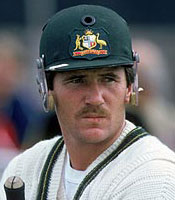
Allan Border


Allan Robert Border, AO (born 27 July 1955) is a former Australian cricket captain. His playing nickname was "A.B.". He played 156 Test matches in his career, a record until it was passed by fellow Australian Steve Waugh. Border still retains the world record for the number of consecutive Test appearances of 153 and the number of Tests as captain. He was primarily a left hand batsman but also achieved sporadic success as a part time left arm orthodox spinner. Border amassed 11,174 Test runs (a world record until it was passed by Brian Lara in 2005). He hit 27 centuries in his Test career. He retired as Australia's most capped player and leading run-scorer in both Tests and ODIs. His Australian record for Test Match runs stood for 15 years before Ricky Ponting overtook him during the Third Ashes Test against England in July 200Border was one of the 55 inaugural inductees of the ICC Cricket Hall of Fame.[2]
Early years
Born in Cremorne, a North Shore suburb of Sydney, New South Wales, Border grew up with three brothers in the nearby suburb of Mosman. His father John, from Coonamble in rural New South Wales, was a wool classer and his mother Sheila was the proprietor of a corner store. The family had a spacious backyard for playing games, and Mosman Oval, the home of district cricket and baseball clubs, was across the street. Border attended North Sydney Boys High School, and earned his leaving certificate in 1972.
Throughout his early years, Border played in cricket teams two or three years older than his age group. He also played for Mosman Baseball Club, where he developed his fielding and horizontal-bat shots. Aged sixteen, he made his début for Mosman in Sydney Grade Cricket as a left arm orthodox spinner and batted at number nine. He won selection for the 1972-73 Combined High Schools team in the intrastate carnival. During this time, he was coached by Barry Knight, a former England international.
Cricket career
Border accumulated more than 600 runs in grade cricket in 1975–76, and at the start of the following season, he made two consecutive centuries to earn selection for NSW.[8] In the absence of a number of Test players, Border made his debut against Queensland at the SCG in January 1977.[9] He compiled 36 and took the last three catches of the match, as his team claimed victory. Border resigned his job as a clerk in the film library of BHP to spend the 1977 English season playing for Downend in the Gloucestershire League. The highlight of his stay was 159 not out in an invitational match against Cambridge University. In Australia, Border compiled 617 runs at 36.29 average during the 1977–78 Sheffield Shield season. He then returned to England and played for East Lancashire Cricket Club in the Lancashire League, scoring 1191 runs at 56.71 and taking 54 wickets at 18.60.[5][11]
Test debut during WSC
In 1977, the breakaway professional competition World Series Cricket (WSC) signed many players who were then banned from first-class and Test cricket, thus leaving many vacancies in the Australian team. Border started the 1978–79 season with his maiden first-class century, 135 against Western Australia at Perth, and followed up with 114 against Victoria at the SCG. After Australia lost the first two Tests in the Ashes series, Border was selected for his Test debut at the MCG. Making a nervous start, he took more than half an hour to score three runs. He made 29 and was run out for a duck in the second innings while attempting a single. In the following Test at Sydney, he was in a "lonely class of his own" by top-scoring in both innings with 60 not out and 45 not out as Australia lost the match and the Ashes. He used his feet to the spinners as his teammates struggled to cope with the turn. However, after scores of 11 and 1 in the Fifth Test at Adelaide he was dropped for the Sixth Test.
Recalled for the First Test against Pakistan at the MCG, Border batted at No. 3 and hit his maiden Test century as Australia reached 3/305, chasing 382 for victory. Border's dismissal for 105 triggered a major collapse of seven wickets for five runs as the other batsmen were unable to cope with the swing of Sarfraz Nawaz. Australia lost by 71 runs. Border made 85 and 66 not out as Australia squared the series with a victory in Perth. In his second Test series, he had topped the batting aggregates and averages with 276 runs at 92.00.
Post-WSC place
In May 1979, the ACB announced an agreement with WSC, which allowed the WSC players to return to international cricket at the start of the 1979-80 Australian season. In the meantime, Australia made two tours, giving the incumbent players an opportunity to press for places in a reunited team. The first tour, to England for the 1979 Cricket World Cup, ended with Australia being eliminated in the first round. Border scored 59 runs in two innings.
This was followed by a three-month-long, six-Test tour of India, on which Australia failed to win a single match. Border scored 521 runs at 43.42 in the Test series, including 162 in the First Test at Madras, where he displayed excellent footwork and handled the Indian spinners much more effectively than his team-mates. As a result of this performance, he was one of only three players to retain their places for the next Test against England at Perth in November 1979 after the WSC players returned. Border scored 115 in the second innings to secure victory and in doing so passed 1,000 Test runs. He had done so in only 354 days, the fastest ever by an Australian, and made more runs (1,070) in his first year as a Test cricketer than anyone before. He was unable to maintain this form, however, and ended the season with 317 runs at 31.70 in six Tests against England and the West Indies.
On the tour of Pakistan that followed, Border hit 150 not out and 153 in the Third Test at Lahore against spinners of the calibre of Iqbal Qasim and Tauseef Ahmed to become the first batsmen in Test history to pass 150 in both innings of a Test. In the off-season, Border married Jane Hiscox, and moved to Brisbane to begin playing for Queensland.[5][24] During the 1980-81 season, he scored 328 runs at 36.44 in six Tests against New Zealand and India, a modest return boosted by a score of 124 against the latter at Melbourne in the final Test of the summer.
Stubborn resistance
In 1981, Border made his first Ashes tour and scored a half-century in each of the first two Tests. "Border alone of the established players came through with reputation enhanced"; in the Fifth Test at Old Trafford when he batted with a fractured left finger. He reached a century in 377 minutes, the slowest Test hundred by an Australian, and remained unbeaten on 123 as Australia lost the match. In the final Test at The Oval, Border scored 106 not out and 84. During this latter sequence, he defied the English bowlers for more than 15 hours to score 313 runs before he was dismissed. Overall, he totalled 533 (at 59.22); this prompted Sir Leonard Hutton to call him the best left-handed batsman in the world and resulted in his selection as one of the Wisden Cricketers of the Year in 1982.
Border's 1981–82 season was mixed. Against Pakistan, he made only 84 runs in three Tests, but against the West Indies, he scored a century and three half-centuries in 336 runs (at 67.20) to help Australia draw the series. On the tour of New Zealand, his three Tests brought only 44 runs at 14.67. After having the winter off, Border returned to Pakistan but was unable to repeat his performances of two years earlier. He scored 118 runs at 23.60 as Pakistan won all three Tests.
After failing in the first three Tests of the 1982–83 Ashes series, Border's place in the Australian team was in jeopardy[citation needed] as Australia led the series 2–0. Border's effort in Australia's loss in the Fourth Test at the MCG is one of his best remembered Test innings. Australia had lost nine wickets and required 74 runs to win when Jeff Thomson joined Border at the crease. 18,000 spectators attended the final day's play as the pair slowly accumulated runs, before a juggling catch dismissed Thomson three runs short of the target. Border then scored pair of 80s in the Fifth Test to secure a drawn match and Australia regained the Ashes. His figures were 317 runs at 45.28 average.

Saturday, February 5, 2011

Inzamam-ul-Haq


Inzamam-ul-Haq (Saraiki, Punjabi, Urdu: انضمام الحق; born 3 March 1970 in Multan, Punjab Province, Pakistan), also known as Inzamam, nicknamed Inzy or the Sultan of Multan, is a former Pakistan international cricketer who was national captain between 2003 and 2007. He is a right-handed batsman who has been regarded as one of the greatest cricketers from Pakistan in modern times.
On October 5, 2007, Inzamam retired from International cricket following the second Test match against South Africa, falling three runs short of Javed Miandad as Pakistan's leading run scorer in Test cricket. Following his retirement, he joined the Indian Cricket League, captaining the Hyderabad Heroes in the inaugural edition of the Twenty20 competition. In the ICL's second edition, he captained the Lahore Badshahs, a team composed entirely of Pakistani cricketers.
Career
One Day International cricket
Inzamam made his One Day International (ODI) debut in a home series against West Indies in 1991, and made a good start to his career by scoring 20 and 60 runs in two matches against West Indies. This was followed by 48, 60, 101, and 117 runs against Sri Lanka.
Handpicked by former Pakistan captain Imran Khan for the 1992 Cricket World Cup in Australia and New Zealand, 22-year-old Inzamam was relatively unheard of before the tournament. To the surprise of many he was persevered with throughout the tournament, coming in at various positions in the batting line-up, despite not being very successful early on. Yet it was his performances at the most crucial stage of the competition that made fans and summarisers take note. Inzamam rose to fame in Pakistan's dramatic semi-final against New Zealand at Auckland. With his side in a precarious position, chasing 262 against an impressive New Zealand side, he hit a fiery 60 run innings from just 37 balls to rescue his side and guide them into the final.[3][4] The innings was regarded as one of the finest World Cup performances.[5] He hit a massive six in that match which was described by David Lloyd as the shot of the tournament.[citation needed]
Inzamam made an equally vital contribution in the final of the World Cup, scoring 42 runs off just 35 balls, helping Pakistan reach a score of 249 after a sluggish start. These innings established Inzamam's billing as a big-game player, although he was unable to replicate his World Cup success in later tournaments.
In total, Inzamam set a record for scoring the most half centuries in One Day Internationals, 83 – though this is now surpassed by Sachin Tendulkar. He also became the second batsman to score 10,000 runs in One-day Internationals (again after Tendulkar) and was named in the ICC World XI for both Tests and One-day Internationals in the 2005 ICC Awards. In his final ODI for Pakistan, playing against Zimbabwe in the 2007 Cricket World Cup, he took three catches whilst fielding, including the last one of the match, ending his One Day career.[8]
[edit] Test cricket

This file is a candidate for speedy deletion. It may be deleted after Tuesday, 1 February 2011.
Inzamam made his Test debut in 1992 against England at Edgbaston. However, he got little opportunity to make an impact in that match – he was not out with a score of 8. However, in subsequent matches he demonstrated a vulnerability against swing bowling which resulted in him being dropped for the final Test of the series after averaging a lowly 13.20 runs per innings. Pakistan went on to secure a famous win in the match, taking the series 2-1.
After the England series, Inzamam aimed to establish himself in the Test side and he achieved this brillianly, helping his side to many memorable victories. One of particular note came against Australia in Karachi, 1994, when he made 58 not out with the tail and helped Pakistan to a one-wicket victory and a 1-0 series win. As well as helping his side to become the top-ranked side in the world for a brief period. He achieved personal success by becoming ICC's number one ranked batsman in 1995 He later went on to reclaim top spot in the rankings in 1997. He remained amongst the top 20 ranked batsmen up until his retirement. He was the number one batsman in the world three times and held the title of the 3rd best batsman several times in his career including an extensive run from 2004-2006 , the last time being after his twin fifties at Lords against England in 2006. The tour of England in 1996 was a particular success for both Inzamam and Pakistan, where Inzamam transformed his batting against seam bowling, averaging 64 runs per innings, with scores of 148, 70, 65, and 35.
His Test career highlights include 329 against New Zealand in Lahore in the 2001-02 season, which is the second highest Test score by a Pakistani and the twelfth highest overall. He also scored a century (184 runs) in his 100th Test, becoming only the fifth player to do so (after Colin Cowdrey, Alec Stewart, Gordon Greenidge and Javed Miandad; Ricky Ponting subsequently emulated the feat). Inzamam made a century in each innings of the second Test match against England in 2005, to become Pakistan's leading centurion with 24 centuries, breaking Javed Miandad's record. His 25th century in the 2nd Test against India on 22 January 2006 made him the 10th player to score 25 or more centuries. He also managed 138 not out when the team was on the brink of a humiliating defeat against Bangladesh, eventually saving the Test match and leading his team to victory. His 92 not out against South Africa in late 2006 again showed his ability to bat in a crisis in a match winning manner. He scored twin half centuries when all appeared lost to draw the first test in Mohali against India in 2005, and also scored 184 runs in his 100th test match in the same away series causing the series to be drawn. He still holds the record for most consecutive half centuries against a country with nine in nine innings against England. This streak started from May 31, 2001 and lasted till July 13, 2006. He scored a century and a half century at Lords in 1996.His 118 against Australia in Hobart almost won the test for Pakistan but Adam Gilchrist's match winning 149 not out made the difference.His average in matches won is second only to Donald Bradman and Kumar Sangakkara.
After announcing that he will retire after the second Test against South Africa, at the stadium where he made his international debut, Inzamam needed 20 runs to surpass Javed Miandad for the record of most runs for a Pakistani Test cricketer. After falling for 14 in the first innings, he was dismissed for 3 in his final innings by Paul Harris, out stumped, leaving him three runs shy of the record. He needed only 70 more career runs for a batting average of 50.
County Cricket
Inzamam made his debut in English county cricket in August 2007 at the age of 37. He joined Yorkshire County Cricket Club as a replacement for Younus Khan who left to play for Pakistan in the 2007 ICC World Twenty20. He was disappointing on the whole, making eight on debut at Scarborough's North Marine Road against Warwickshire before making nine and seven in his opening Pro40 games.
Indian Cricket League
In 2007, Inzamam joined the unsanctioned Indian Cricket League. In the inaugural competition, Inzamam captained the Hyderabad Heroes and scored 141 runs in 5 matches. In the 2008 competition in March, Inzamam captained the Lahore Badshahs, composed entirely of Pakistani cricketers. Lahore Badshah managed to win the ICL T20 tournament in 2008/09.
The move to the ICL has proved to be a controversial one for Inzamam. The PCB's stance on players joining unsanctioned leagues has meant that he has been banned from playing in any domestic competitions in Pakistan or any involvement with the international team.However, given Inzamam's recent retirement, this is unlikely to affect him.
It is reported that he was paid Pakistani Rs. 10 Crore (US $1,100,000) which was the highest salary for any player participating in the league along with the likes of Brian Lara.
Playing style

I think Inzamam is as talented as Brian Lara and Sachin Tendulkar but little does he realise his true talent

— Former Pakistan captain Imran Khan.
Inzamam has been known to be a very destructive batsman in both One Day Internationals (ODIs) and Test matches. He has the ability to pick the length of a delivery very early and play very late. His footwork is generally considered to be fast, enabling him to position himself early for shots. He averaged just under 50 runs per innings in Tests and nearly 40 runs in ODIs, with a strike rate of 54.03 and 74.23 respectively. Inzamam is especially strong when playing shots off his legs and has been considered to be amongst the best employers of the pull-shot in world cricket.
His batting style has brought him fans from all over the world. He was called "the best batsmen in the world against pace" by Imran Khan, because "he seems to have so much time on his hands before the ball reaches him".
Inzamam does, however, have a reputation for being a poor runner between the wickets. He has the dubious distinction of being run-out the second highest number of times in ODIs having been run-out 40 times [behind Marvan Atapattu (41 times)].
Captaincy
Inzamam captained Pakistan in thirty Tests, winning eleven, drawing nine and losing ten. Only three players have captained Pakistan in more Test matches, but all have better win-loss records and only Imran Khan has a lower win percentage than Inzamam. Although the Oval Test match in 2006 was poised as a victory for Pakistan before the controversy took place and had it not occurred, Inzamam's record would have had a win more and a loss less. However, Inzamam held the captaincy until March 2007, the longest captaincy tenure since 1992, when Imran Khan retired.
Captaincy had a positive effect on Inzamam's batting, often leading by example in pressure situations, averaging greater as a captain (52) than without (50). In ODI's Inzamam also held the highest average as captain in ODI's [27] and is currently third on that list behind the current Australian skipper Ricky Ponting and the Indian captain Mahendra Singh Dhoni. After early failures in Australia, he took a depleted Pakistan side to India in 2005 and played an important role in securing a draw by winning the final test match from an unlikely position with an innings of 184 runs. He subsequently lead his side to an ODI success against West Indies (away), England (home) and Sri Lanka (away) as well as Test Series victories against England (home), India (home), Sri Lanka (away). Inzamam had seemed to have united the Pakistan side and victories lead them to 2nd place in the ICC Test Rankings and 3rd place in the ICC ODI Ranking. The latter part of Inzamam's tenure as Pakistan captain was less successful and the team was embroiled in many controversies culminating in a disappointingly early exit from the 2007 Cricket World Cup at the hands of lowly ranked Ireland.
In the 2007 Cricket World Cup, Inzamam captained the Pakistani team to its first loss to associate ICC member Ireland (on St Patrick's Day). This result and their previous loss to West Indies, led to them being knocked out of the tournament. A day later he announced his retirement from One Day International Cricket and resignation as Test captain. The announcement was made the same day that Bob Woolmer, Pakistan's coach, died in his hotel room in Kingston, Jamaica. He dedicated his final ODI to Woolmer to whom he shared a good relationship with for three years and affectionately

History of Post Office


Post offices are important, not only to facilitate communication, but also to establish the name by which an unincorporated community's identity is carried through time. Using Planter on Key Largo as an example, the first line on the U.S. Postal proposal form dated November 10, 1891 was, "The proposed post office is to be called: Planter." Benjamin Franklin is generally called the father of the American postal service, as he was the first Postmaster General under the 1775 Continental Congress. Congress established the Post Office Department as a branch of the Treasury Department in 1789.
Monroe County came into existence on July 3, 1823. Key West was incorporated in 1828. The first Monroe County post office was opened in February 1829, in a building on the corner of Caroline and Front Streets in Key West. Rural delivery for most parts of the Upper Keys began in July 1961. Now we will consider the Upper Keys post offices.
INDIAN KEY Indian Key was not far behind Key West in time when its post office was established on May 21, 1833 with Silas Fletcher as postmaster. Fletcher was followed by Henry Waterhouse on April 19, 1834 and Charles Howe on February 9, 1835. In 1836, Indian Key became the seat of Dade County. Following the 1840 Indian massacre, on March 15, 1842, John Marshall was appointed postmaster and in September of the same year, Luther Hopkins was the postmaster. The post office was discontinued on May 29, 1843.
Postal research records generally use four verbs in referring to post offices: 1) Establish means one had never been there before. 2) Re-establish means to re-open a previous post office location. 3) Changed from means a name change for an existing post office, or delivery changed to another location. 4) Discontinued means to close.
A post office was not re-established until November 1, 1850 with William Hillard as postmaster. It appears that he served until it was discontinued again on August 5, 1872 and it is not clear of the specific use of the island during this time. According to the 1870 census it was mostly marine use and farming.
This was not the end, however, as the Alligator Reef Lighthouse was pre-assembled on Indian Key in 1873 and the post office was re-established with E. Ware as postmaster on March 11, 1873, but again discontinued November 20 of the same year. Once again, the post office re-established with William H. Bethel as postmaster on May 5, 1880 and discontinued again on September 21, 1880. Some may wonder why a post office was needed, but Indian Key was a bustling little community. Three known schooners (Emma, Euphemia and Clyde) were built in the 1870 and 1880 period. Officially, 1880 appears to be the death of the Indian Key post offices; however, once each year stamps are canceled during the Indian Key Festival.
PLANTER Sailboats provided the first mail service for the Keys. The 10-ton sailing ship Post Boy was awarded the first mail delivery contract and made round trips between Charleston and Key West. Her service was described as "regular irregularity" taking about two months for a round trip. A Key West attorney, William Hackley, in 1831 received two letters from his mother mailed one year previously from Virginia.
In 1848, the 1,100-ton, side-wheeler steamship Isabel began making semi-monthly mail runs and service was fairly reliable until the Civil War. Service reverted back and forth with sail and other boats until the railroad.
Our own early settlement of Planter on the south end of Key Largo was approved for a post office on December 23, 1891 with John Wesley Johnson (son of patriarch Mr. Sam) as postmaster. See the 1906 photo at the top of the page. The big, steam side-wheeler, now the City of Key West, could not go safely into the shallow waters of the Planter harbor, so John drove a wooden piling in deep water on which he attached two mail bag hangers - one for incoming and one for outgoing mail.
Daily he would place the mailbag on the piling and pick up a mailbag from either Key West or Coconut Grove, depending on which way the ship was traveling. This was effectively two-day mail service, which was not bad for a pineapple community. Presumably, the hurricanes of 1909 and 1910 did enough damage to the community that the Planter post office closed on October 15, 1910. Two other factors probably effected the closing of the post office. One is a pineapple blight reduced the pineapple production. Two is the railroad began daily service to the Upper Keys in 1908 and its location on the other side of the island could have attracted families to move away from coast to be near this new activity. Some combination of the three seemed to doom the Johnson location of the post office. This left the southern end of the island of Key Largo without local mail service. Mail service was changed to Islamorada which had had mail service by railroad since 1908.
ISLAMORADA In 1908, Henry Flagler's Overseas Railroad brought semi-reliable mail service to all the Upper Keys. The same year Islamorada established its first post office. The first official post office application for Islamorada that I could find was made by Elsie M. Rue. Islamorada had a population of 150-200 at that time. John H. Russell had been appointed postmaster before this on June 1, 1908. Elsie M. Rue was appointed postmaster on October 21, 1908 and John A. Russell appointed on June 2, 1909.
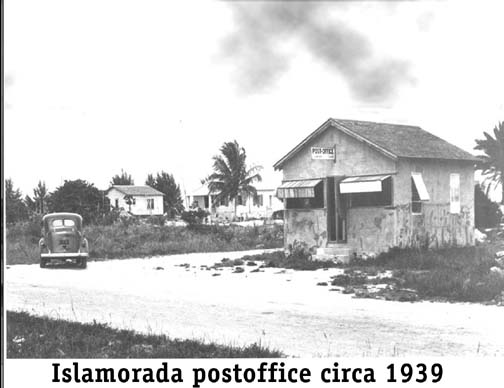
When Bernard Russell's father, John A. Russell, became postmaster in 1909 he built a wooden post office building near the train depot. Later, this building was moved behind the depot and fronting the highway. In 1926 he began building a coral-rock post office building. Attached on the south end was a store, restaurant and gas station. The old concrete foundation for the post office is still there just behind the present "Marine Bank (1999)" and south of the present post office at mile marker 82.8, oceanside. No photo survives of this post office, so its replacement after the 1935 Hurricane is shown. This is now (1999) Marty's TV.

Viv Richards


Sir Isaac Vivian Alexander Richards, KGN, OBE (born St John's, Antigua on 7 March 1952) is a former West Indian cricketer. Better known by his second name, Vivian or, more popularly, simply as Viv or King Viv[1] Richards was voted one of the five Cricketers of the Century in 2000, by a 100-member panel of experts, along with Sir Donald Bradman, Sir Garfield Sobers, Sir Jack Hobbs and Shane Warne.[2] In February 2002, he was judged by Wisden to have played the best One Day International (ODI) innings of all time.[3] In December 2002, he was chosen by Wisden as the greatest ODI batsman of all time, as well as the third greatest Test batsman of all time, after Sir Don Bradman and Sachin Tendulkar.
Contents

Personality and playing style
Richards was a very powerful right-handed batsman with an extremely attacking style, besides being an excellent fielder, and a handy off-spin bowler. He is often regarded as the most devastating batsman that ever played the game by cricketers, journalists, fans and others alike, and played his entire career without a helmet, across the 17 years from 1974 till 1991Several prominent personalities including former cricketer and legendary fast bowler and all-rounder Imran Khan and noted writer John Birmingham are of the opinion that Richards was the best ever batsman against genuine fast bowling.Many other former players of the game rate him extremely high overall as a batsman. Ian Chappell rates him the second-greatest batsman he ever saw after Sir Garfield Sobers,while for Barry Richards, Ravi Shastri and Neil Fairbrother, he remains the best batsman they ever witnessed. Wasim Akram rates Richards the greatest batsman he ever bowled to, ahead of Sunil Gavaskar and Martin Crowe. Martin Crowe, arguably the greatest batsman to have ever emerged from New Zealand, rates Viv Richards as the greatest, the most destructive, and the most intimidating batsman he ever saw. Richards was also Crowe's cricketing idol along with Donald Bradman, Garfield Sobers and Greg Chappell.

The ICC came out with their rankings for the best batsmen and bowlers in the history of the game for both the longer and shorter versions. The ratings for Test Cricket had Vivian Richards ranked at 5 after Sir Donald Bradman, Sir Len Hutton, Sir Jack Hobbs, and Peter May.[15] The ODI ratings again had Richards comfortably perched at 1 followed by Zaheer Abbas and Greg Chappell These rankings were based on the level achieved by the batsmen at their respective peaks and did not take other factors into consideration, on account of which, they were considered controversial by some followers of the game.
In 2004, in a poll by ESPN, participated in by 15 of the leading names in cricketing history, Richards was voted the third greatest ever player after Bradman and Sobers, and the second greatest ever batsman after Bradman. He was also voted the greatest cricketer since 1970 by another poll ahead of Ian Botham and Shane Warne.[18] That poll saw both Botham and Warne vote for Richards, and in the opinions of both, Richards is the greatest batsman they ever saw. In 2006, in a study done by a team of ESPN's Cricinfo magazine, Richards was again chosen the greatest ODI Batsman ever. Former cricketer Derek Pringle also rates Richards to be the best batsman ever in the history of Limited Overs Cricket.
His fearless and aggressive style of play, and relaxed but determined demeanor made him a great crowd favorite and an intimidating prospect for opposition bowlers all over the world. The word "swagger" is frequently used to describe his batting style. His batting often completely dominated opposing bowlers. He had the ability to drive good-length balls from outside off-stump through midwicket, his trademark shot, and was one of the great exponents of the hook shot.
International career
Richards made his Test match debut for the West Indian cricket team in 1974 against India in Bangalore. He made an unbeaten 192 in the second Test of the same series in New Delhi. The West Indies saw him as a strong opener and he kept his profile up in the early years of his promising career.
In his Test career, he scored 8,540 runs in 121 Test matches at an average of 50.23 (including 24 centuries). Richards also scored 5 centuries in World Series Cricket between 1977–79. These are not recognised by the ICC as "official" Test centuries, but the high standard of cricket played in this series means that they can arguably be ranked alongside his 24 Test centuries. Richards won 27 of 50 matches as a Test captain, and lost only 8. He is also the scorer of the fastest-ever Test century, from just 56 balls against England in Antigua during the 1986 tour. He hit 84 sixes in Test cricket. His highest innings of 291 is sixth on the list of West Indies' highest individual scores.
In 1975 Richards helped the West Indies to win the inaugural Cricket World Cup, a feat he later described as the most memorable of his career. He starred in the field, running out Alan Turner, Ian Chappell and Greg Chappell. The West Indies were again able to win the following World Cup in 1979, thanks to a Richards century in the final at Lord's, and Richards believes that on both occasions, despite internal island divisions, the Caribbean came together. He was until 2005 the only man to score a century and take 5 wickets in the same one-day international, against New Zealand at Dunedin in 1986–87. He rescued his side from a perilous position at Old Trafford in 1984 and, in partnership with Michael Holding, smashed 189 to win the game off his own bat.
1976 was perhaps Richards' finest year: he scored 1710 runs, at an astonishing average of 90.00, with seven centuries in 11 Tests. This achievement is all the more remarkable considering he missed the second Test at Lord's after contracting glandular fever; yet he returned to score his career-best 291 at the Oval later in the summer. This tally stood as the world record for most Test runs by a batsman in a single calendar year for 30 years until broken by Mohammad Yousuf of Pakistan on November 30, 2006.
Richards captained the West Indies in fifty Test matches from 1984–1991. He is the only West Indies captain never to lose a Test series, and it is said that his fierce will to win contributed to this achievement. His captaincy was, however, not without controversy: one incident was his aggressive, "finger-flapping" appeal leading to the incorrect dismissal of England batsman Rob Bailey in the Barbados Test in 1990, which was described by Wisden as "at best undignified and unsightly. At worst, it was calculated gamesmanship". This behaviour would nowadays be penalised according to Section 2.5. of the Rules of Conduct of the ICC Code of Conduct.

Friday, February 4, 2011

Hino


Hino Motors, Ltd. (日野自動車株式会社, Hino Jidōsha, TYO: 7205 ), commonly known as simply Hino, is a manufacturer of diesel trucks, buses, and other vehicles, based in Hino, Tokyo, Japan. Since 1973 the company has been the leading producer of medium and heavy-duty diesel trucks in Japan. It is a subsidiary of Toyota Motor Corporation.

History
The company traces its roots back to the founding of Tokyo Gas Industry Company in 1910. In 1910 Chiyoda Gas Co. was established and competed fiercely against incumbent Tokyo Gas Company fighting for gas lighting users. Tokyo Gas Industry was a parts supplier for Chiyoda Gas but it was defeated and merged into Tokyo Gas in 1912. Losing her largest client, Tokyo Gas Industry Co. broadened their product line including electronic parts, and renamed herself as Tokyo Gas and Electric Industry(東京瓦斯電気工業), TG&E and was often abbreviated as Gasuden. It produced its first motor vehicle in 1917, the Model TGE "A-Type" truck. In 1937, TG&E merged its automobile division with that of Automobile Industry Co., Ltd. and Kyodo Kokusan K.K., to form Tokyo Automobile Industry Co., Ltd., with TG&E as a shareholder. Four years later, the company changed its name to Diesel Motor Industry Co., Ltd., which would eventually become Isuzu Motors Limited.
The following year (1942), the new entity of Hino Heavy Industry Co., Ltd. spun itself out from Diesel Motor Industry Co., Ltd., and the Hino name was born. Following the end of World War II, the company had to stop producing large diesel engines for marine applications, and with the signing of the treaty, the company dropped the "Heavy" from its name and formally concentrated on the heavy-duty trailer-trucks, buses and diesel engines markets, as Hino Industry Co., Ltd. The company took its name from the location of its headquarters in Hino (日野市, Hino-shi?) city within Tokyo prefecture.
To sharpen its marketing focus to customers, in 1948, the company added the name "Diesel" to become Hino Diesel Industry Co., Ltd.
In 1953, Hino entered the private car market, by manufacturing Renaults under licence, and in 1961 it started building its own Contessa 900 sedan with an 893cc rear-mounted engine. The Italian stylist Giovanni Michelotti redesigned the Contessa line in 1964 with a 1300cc rear-mounted engine. Fed by two SU type carburettors, this developed 60 hp (44 kW) in the sedan and 70 hp (51 kW) in the coupé version. However, Hino ceased private car production very quickly in 1967 after joining the Toyota group.
Hino Trucks are also assembled in The Republic of Ireland by J Harris on the Naas/Nangor Roads.

Products
Trucks
Ford N Series trucks (sold 1980-1998 in Oceania) These were badge-engineered Hino Ranger models.
Profia (previously Super Dolphin Profia), sold as Hino 700 for export - heavy duty truck
Bonneted medium truck (for North America) - coded Hino 600.
Dutro - light truck, hybrid vehicle version available, sold as Hino 300.
Ranger 2 FA, FB, FC - light trucks replaced by Dutro.
Ranger - also sold as Hino 500, medium to heavy truck
The Ranger KL was first introduced in 1969
The 2nd generation was launched in 1980
The 3rd generation of 1989 is called Rising Ranger and Cruising Ranger.
The latest 4th generation (Ranger Pro) came in 2002, Hybrid vehicle version available.
The first generation Ranger KL spawned into KM, KR, and other variants. In Australia.
Hino has competed in the Dakar Rally since 1991 with a Ranger FT 4WD truck driven by the Japanese rally driver, Yoshimasa Sugawara. Hino has always finished in the Top 10 in the Camion Category, and 1-2-3 overall in the 1997 event.
155 Class 4 - light duty truck
165 Class 4 - medium duty truck
185 Class 5 - medium duty truck
258 Class 6 - medium duty truck
268 Class 6 - medium duty truck
338 Class 7 - heavy duty truck
358 Class 7 - heavy duty truck
Hino also sells the European truck Scania R420 in Japan, into an agreement with the Swedish brand.