Fashion

Fashion

Wednesday, January 26, 2011

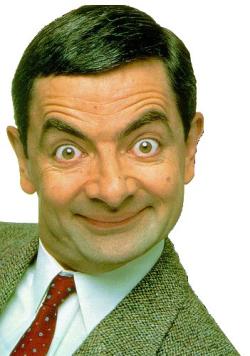
Mr. Bean


Mr. Bean is a British comedy television series of 14 half-hour episodes starring Rowan Atkinson as the title character. Different episodes were written by Atkinson, Robin Driscoll, Richard Curtis and one by Ben Elton. The first episode was broadcast on ITV on 1 January 1990,[2] with the final episode, "Hair by Mr. Bean of London", on 15 November 1995. Based on a character developed by Atkinson at university, the series followed the exploits of Mr. Bean, described by Atkinson as "a child in a grown man's body",[3] in solving various problems presented by everyday tasks and often causing disruption in the process. During its five-year run the series gained large UK audience figures, including 18.74 million for the 1992 episode "The Trouble With Mr. Bean".[4] The series has been the recipient of a number of international awards, including Rose d'Or. The show has been sold in 200 territories worldwide, and has inspired two feature films and an animated cartoon spin-off.[5]The title character, played by Rowan Atkinson, is a slow-witted and selfish yet likeable buffoon who brings various unusual schemes and contrivances to everyday tasks. He lives alone in his small flat in Highbury, North London, and is almost always seen in his trademark tweed jacket and a skinny red tie. He also usually wears a digital calculator watch (which he does not like to lose). Mr. Bean rarely speaks, and when he does, it is generally only a few mumbled words which are in a comically low-pitched voice. His first name (he names himself "Bean" to others) and profession, if any, are never mentioned. In the first film adaptation, "Mr." appears on his passport in the "first name" field, and he is shown employed as a guard at London's National Gallery.[12] In Mr. Bean's Holiday, however, his name is listed on his passport as "Rowan".[13]
Mr. Bean often seems unaware of basic aspects of the way the world works, and the programme usually features his attempts at what would normally be considered simple tasks, such as going swimming, using a television set, redecorating or going to church. The humour largely comes from his original (and often absurd) solutions to problems and his total disregard for others when solving them, his pettiness, and occasional malevolence.
At the beginning of episode two onwards, Mr. Bean falls from the sky in a beam of light, accompanied by a choir singing Ecce homo qui est faba ("Behold the man who is a bean"). These opening sequences were initially in black and white in episodes 2 and 3, and were intended by the producers to show his status as an "ordinary man cast into the spotlight". However, later episodes showed Mr. Bean dropping from the night sky in a deserted London street, against the backdrop of St. Paul's Cathedral suggesting Bean is an alien. At the end of episodes 3 and 6 he is also shown being sucked right back up into the sky in the respective background scenes (black scene in episode 3 and street scene in episode 6). Atkinson himself has acknowledged that Bean "has a slightly alien aspect to him";[14] in the animated series, he was actually shown to be an extraterrestrial.

Tuesday, January 25, 2011

The Miss World History


The year was 1951. The competition was the first Miss World pageant, introduced as part of the Festival of Britain celebrations, and it was the audience it attracted who guaranteed its success.

Thanks to founder Eric Morley’s PR expertise, the first Miss World pageant welcomed a global audience greater than international events like the World Cup and the Olympic Games. The BBC televised Miss World from 1959 to 1979 and Thames Television picked up the contract from 1980 to 1988. At its peak, the show claimed an audience of 27.5 million in Britain alone a figure comparable to that of a royal wedding Fifty years on from the first pageant, Miss World still pulls in the crowds and can boast an annual audience of over a billion.

The press went to town - the world’s most beautiful women, 26 in all, gathered together in one place and happy to smile at the battery of photographers.

The 1950s

The first Miss World, Sweden's Kiki Haakonson, was the first and last winner to be actually crowned in a two-piece swimsuit.
During the first decade of the pageant’s success, the outfits of contestants continued to raise eyebrows and grab headlines. In 1959, Loretta Powell of the United States arrived at the House of Commons in London clad in a Stetson, ruffled shirt and cowboy trousers. She may have got away with wearing what at the time was considered a tad outrageous, but she didn’t get away with her ‘guns’. The two stern-faced coppers in charge demanded she hand over her ‘firearms’ - even copies are not allowed in the British Parliament.

1951 1952 1953 1954 1955 1956 1957 1958 1959

The 1960s

In 1966, India enjoyed its first success and Reita Feria proved to be a popular winner. As articulate and charming as she was beautiful, she went on to qualify as a doctor, highly respected for her brains and expertise rather than her looks. The decade finished with Sweden's Eva Ruber Staier winning the title. Later making her name in movies, Eva had a sweet tooth and when asked how she would spend her prize money, told the waiting press that: 'I'll buy lots of chocolate.'

1960 1961 1962 1963 1964 1965 1966 1967 1968 1969

The 1970s

The first Miss World contest of the decade, hosted by the legendary Bob Hope, was marred by feminist protesters. The quick-witted comedian simply shook his head in wonderment and remarked, "Anyone who would try and break up an affair as wonderful as this has got to be some kind of dope."
In that 1970 Miss World, two black women - Jennifer Hosten of Grenada and Pearl Jansen of Africa South - claimed first and second place, something that had never happened before at a major international pageant.

Despite feminist protests, Miss World was achieving monumental television audiences throughout the 1960s and 1970s. In the UK, Miss World 1970 was the single most-watched show of the entire year.

Wilnelia Merced (Miss Puerto Rico) won the 1975 competition. Wilnelia enjoyed a successful reign. She went on to marry one of Britain's best loved entertainers Sir Bruce Forsyth.

By 1979 the show was topping 500 million viewers world-wide. Gina Swainson won the day, as the little island of Bermuda celebrated her victory by declaring a national holiday.

The 1980s

In 1980, major changes in the Miss World judging process were implemented. For the first time personality and intelligence came into the evaluation and, of equal importance was that vital statistics were no longer deemed vital.

In 1983, the last UK winner of Miss World, Sarah-Jane Hutt, from Poole in Dorset, took the title at The Royal Albert Hall. Three years later, Halle Berry, then Miss USA, stunned the judges and audiences when she wore a bikini featuring stars and ropes of beads during a parade of national costumes. At the time she was quoted as saying that she wanted "to catch the eye from the start." Halle failed to win the contest, but as an Oscar-winning Hollywood star with a string of smash hits under her belt, she almost certainly has recovered from the disappointment. The decade finished with the first-ever Polish winner Aneta Kreglicka.

The 1990s

The one and only time that Miss World was held in the United States was in 1991 and it was there, in Atlanta, Georgia, that Ninibeth Leal won her crown, before becoming one of Venezuela's most successful models.

The years 1992 to 1995 marked a particularly successful period for the Miss World contest as the finals moved to Sun City, South Africa and viewer figures increased from 1.2 billion to 1.8 billion. The contestants were welcomed by none other than President Nelson Mandela and over one million people turned out to see them in Johannesburg.

In 1994 Aishwarya Rai became the second Indian winner after a 28 year gap, her win marking the start of a golden age for Indian contestants who took the crown in four out of the next seven years while Aishwarya went on to become Bollywood's biggest female star.

The show's first visit to the Indian continent came in 1996 when over 40,000 people turned out to watch the show at Bangalore's cricket stadium. Irene Skliva won the title of the first-ever Greek Miss World.

In 1999, the show came to London's Olympia. A few protesters turned up to throw flour bombs, but it merely prompted the late Eric Morley to quip, "It's just like the good old days. Who would have thought it would go on for half a century?" Who indeed?

The start of a new century

Miss World reached its half-century in the year 2000 and the contest returned to London, to the Millennium Dome, for the 50th anniversary show. A massive television audience of 2.3 billion witnessed India retain the Miss World crown and in the UK alone more than 8 million people tuned in during the two-hour broadcast on Channel 5.

Miss World 2001, Agbani Darego was the first black African winner and the following year Miss World was staged in her homeland, in Abuja, Nigeria.

The 2007 contest took place in the Crown of Beauty Theatre, Sanya, in the People's Republic of China. The 106 contestants recorded the official torch relay anthem Light the Passion, Share the Dream for the 2008 Olympics Games as a major cooperation between the Beijing Olympic Committee and Miss World Ltd. The song had its first broadcast to a global audience at the 57th Miss World final on December 1 2007, when model Zhang Zilin became Miss World. Zhang was born in 1984, more than thirty years after the start of the Miss World pageant.

With Julia Morley as Chairman, Miss world continues to break records. With franchises in over 120 countries and fundraising topping £150 million, who knows what the rest of this century will bring for Britain's most successful ever international television show.

Priyanka Chopra

Chopra made her debut in the 2002 Tamil film Thamizhan playing the role of Priya, the love interest of the protaginist in the film played by Vijay. The film was praised for its wit, although the depth of Chopra's character was seen as lacking.[9] Chopra also sang playback in the film, singing "Ullathai Killadhe" along with Vijay.

In 2003, she appeared in her first Bollywood film, opposite Sunny Deol and Preity Zinta in the Anil Sharma film The Hero: Love Story of a Spy. She played a supporting role as a doctor named Shaheen in a film The New York Times described as "ripping its text from the seething border tensions between India and Pakistan, spicing its conflict with hot-tempered religious zealots bent on nuclear havoc".[10] Despite being one of the highest grossing films of that year, the overall film was not well received by critics,[11] Chopra was awarded mostly good reviews for her debut Hindi performance.[12] Later that year she appeared in Raj Kanwar's Andaaz, playing the character of Jiya who falls in love with Raj Malhotra, played by Akshay Kumar. The film was a considerable box office success,[11] earning her a Filmfare Best Female Debut Award and a nomination for Filmfare Best Supporting Actress Award. Rediff.com said of her role, "Priyanka clicks with the audience thanks to her skimpy outfits".[13]

Her next few films released in 2004 like Plan, Kismat and Asambhav performed poorly at the box office.[14] Later that year she appeared in David Dhawan's romantic comedy Mujhse Shaadi Karogi playing the role of a young fashion designer Rani along with Salman Khan and Akshay Kumar, the film turned out to be the third highest grossing film of that year.[15] She next starred in Aitraaz. It was her first negative role. Her performance won critical acclaim[16] and earned a Filmfare Best Villain Award. She also received a second nomination for Filmfare Best Supporting Actress Award for the role. Film critic, Subhash K Jha, noted: "A star is born! As the predatory social-climbing seductress who can go to any length to satiate her lust for life, Priyanka Chopra rocks the scene like never before. The film is undoubtedly a triumph for Priyanka Chopra. With half a smile, a twitch of her lip and a movement of her eyebrow she seems to slip into her man-eater's role with captivating ease".[17] In the same year, she participated in a world tour titled Temptations 2004 with other Bollywood actors, including Shahrukh Khan, Saif Ali Khan, Rani Mukerji, Preity Zinta and Arjun Rampal.

In 2005, she starred in six films. Her four films, Blackmail, Karam, Yakeen and Barsaat failed to do well.[14] But her other two releases, Waqt: The Race Against Time and Bluffmaster did decent business at the box office.[18][14] In 2006, Chopra starred in two of the most successful films of the year - Krrish and Don – The Chase Begins Again.[19] Then in 2007 she starred in Nikhil Advani's ensemble piece, Salaam-e-Ishq: A Tribute To Love. The movie failed to do well at the box office.[20] Chopra's next release; the much delayed, Big Brother also underperformed.

Chopra as a supermodel in Madhur Bhandarkar's Fashion which won her the National Film Award for Best Actress and also the Filmfare Best Actress Award.

In 2008, Chopra featured in six films. Her first four films, Love Story 2050, God Tussi Great Ho, Chamku and Drona, failed to do well.[21] Chopra's fifth release of the year, Madhur Bhandarkar's Fashion was a critical success. The film revolved around the fashion world and Chopra's role was that of an ambitious model. Her performance in the film was appreciated and earned her several awards for Best Actress including the National Film Award for Best Actress and also the Filmfare Best Actress Award.[22] Film critic, Subhash K Jha said of her performance, "Her transformation from the bubbly Chandigarh girl to the super-ambitious supermodel, who dumps her boyfriend and conscience to pursue her dreams, is achieved with a gentle subtlety and bridled passion. This is Priyanka’s coming-of-age film. She looks like a zillion bucks. And acts like a woman who connects with the darkest, most desperate human emotions without wallowing in them."[23] Chopra's final release of the year was Tarun Mansukhani's romantic comedy Dostana. The film was a moderate financial success.[21][24] Her performance was praised by the critics, with Rajeev Masand stating: "Priyanka Chopra, is at complete ease, slipping effortlessly into the role of the hottie-with-a-heart-of-gold; she looks smashing in this film, better than she's ever looked before."[25]

In 2009, she appeared in Vishal Bhardwaj's Kaminey alongside Shahid Kapoor, playing the role of a feisty Marathi girl named Sweety. Her performance in the film was described by critic Taran Adarsh: "Priyanka is first-rate. She's so much in sync with her character. Also, she gets the Maharashtrian accent perfect".[26]

She subsequently appeared in Ashutosh Gowariker's What's Your Raashee?, a film in which Chopra became the first actress in the world to portray 12 distinct characters on screen.[27] She is being considered for inclusion in an upcoming edition of Guinness World Records for this feat.[28] The film itself, however, was a financial and critical failure.[29][30] But, Chopra's performance in the film was highly appreciated by the critics, film critic Taran Adarsh said: "What's Your Raashee? belongs to Priyanka Chopra. No two opinions on that. Words would fail to do justice to the remarkable portrayal of twelve different characters by this actor. This is her finest work to date."[31]

In 2010, Chopra appeared in Jugal Hansraj's Pyaar Impossible where she portrayed the role of a college beauty who eventually falls in love with a geek. The film was a financial and critical failure. Her next release, Siddharth Anand's Anjaana Anjaani alongside Ranbir Kapoor, got a good initial response at the box office, but was not well received by the critics. She was also appointed as a UNICEF Goodwill Ambassador in 2010.[32]

Chopra has completed working on Vishal Bhardwaj's 7 Khoon Maaf, in which she plays the role of an Anglo-Indian woman with seven husbands. She has recently completed the first schedule of Farhan Akhtar's Don 2 – The Chase Continues alongside Shahrukh Khan in Berlin. And she has also been finalized for Anurag Basu's Barfee alongside Ranbir Kapoor, in which she reportedly plays the role of a mentally challenged girl. And recently, she has also confirmed that she will be doing Agneepath remake and Krrish 2 alongside Hrithik Roshan.[

Aishwarya rai


Aishwarya Rai Bachchan[1] (née Aishwarya Rai,Tulu: ಐಶ್ವರ್ಯಾ ರೈ, pronounced [əjɕʋərjaː rəj]; born1 November 1973) is an Indian actress and formerMiss World. Before starting her acting career, she worked as a model and gained fame after winning the Miss World title in 1994. During her career, Rai has acted in over 40 movies in Hindi, English, Tamiland Bengali, which include a number of international productions.

Often cited by the media as the most beautiful woman in the world,[2][3][4] Rai made her movie debut in Mani Ratnam's Tamil film Iruvar (1997) and had her first commercial success in the Tamil movieJeans (1998). She came to the attention ofBollywood in the movie Hum Dil De Chuke Sanam(1999), directed by Sanjay Leela Bhansali. Her performance in the film won her the Filmfare Best Actress Award. In 2002 she appeared in Bhansali's next project, Devdas (2002), for which she won her second Filmfare Best Actress Award.

After a low phase in her career during 2003–2005, she appeared in the blockbuster Dhoom 2 (2006), which turned out to be her biggest Bollywood commercial success. She later appeared in films like Guru (2007), Jodhaa Akbar (2008), and Enthiran(2010) which were commercially and critically successful. Rai has thus established herself as one of the leading contemporary actresses in the Indian film industry.